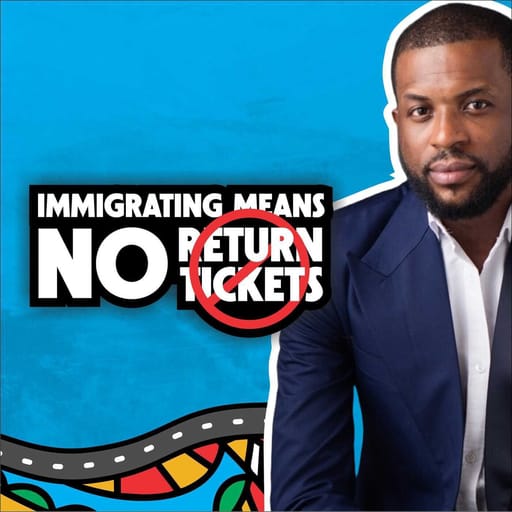
Transcript 0:00 But y-you know, one thing I found interesting what, uh, Chris said was the idea of the return ticket, 0:08 which is when you're an immigrant, so like when I got my Canadian PR, the visa that I was given was just one way, and then I also bought a one-way ticket. 0:19 So it, it's different, 'cause when you're a visitor, you're like, you sort of know that, like you have a return ticket. You can always go back, you know. 0:27 Like, so I don't like, I don't like how they behave, I can go back. I don't like these things about, these things about the people, I can just go back home. 0:35 Literally, I don't have to try to integrate, integrate into the society. But when you move, like when you move to the place, there's no return ticket. You can't escape anything. You're there. 0:47 [laughs] But let's get into it. [intro jingle] Welcome, man. How's it going? Well, going well. Uh, it's winter, so I mean, obviously. 1:04 [laughs] Wait, look, talking about winter, I think you all, you all are still way better than we are. 1:09 I mean, the weather is warm right now, but the last two weeks, like I was saying to you during the pre-show, the last two weeks have just been- Hmm... been a mess. But, um- I can imagine... 1:18 let's just, let's just kind of dive straight into it. Um, I think the first question I wanna just get on with, with you was basically around like, why Glasgow? 1:29 I mean, people always, people always think about, so Chris moved from Nigeria to Glasgow, Lagos to Glasgow, to be, to be direct, to be straight up. And people always move to London, the States, you know, Canada. 1:41 I mean, Canada is the new one now. Like, 'cause everyone moves to Canada. Germany, people move to Germany, Australia, but not Glasgow. Like, I mean, like I, I [laughs] why Glasgow, to be honest? 1:52 [laughs] Well, yeah, to be honest, I... There's no, uh, I really don't have a good answer in the sense that- [laughs]... there was no particular reason. I mean- Okay... 2:02 I, I just, it was sort of like leaving Nigeria was, was, uh, was an act of fate. It was sort of like, you know- Mm... adventure. Get out, you know, just go to the world and see stuff. 2:13 And I think it was when I was just trying to look for certain things, and at the time, Glasgow just seemed to tick those boxes, you know. 2:20 Being a place where there has rich culture, history, you know, see classical buildings around you and, and that. So I mean, if I knew about the weather, I probably wouldn't come, but [laughs] I didn't know that part. 2:34 Yeah, so it's my... I mean, and, and th- th- well, this is sort of like my second time in the UK, you know. The first time was, was, I mean, I was pretty much in England, London, and all of that, you know. 2:44 So but now I just thought, "Okay, let me try and explore another place." So I didn't really have a particular reason. It's more like I wish I n- knew this much before making the move. 2:53 It wouldn't have been-- I suppose it wouldn't have been Glasgow, but I supp- you know, you would probably say everything happens for a reason. So- Yeah, yeah... but yeah, so far so good. Glasgow is, is great. 3:01 Glasgow is cool and yeah. I, I, I have two questions I wanna ask, like kind of follow-up questions. Um, well, I like the point you make about classical buildings. I think one thing I really like about the UK is how, 3:12 or a lot of parts of the UK, is how they manage to keep that balance of old and new. It's so interesting how they do that. 3:18 So you come into a city, it's a new c- it's, it's a modern city, but it still has all the trappings of history in it, and it just feels, I don't know, I don't know how that feels. 3:29 Like, but it does have-- I wish someone had a word to describe what that thing does to you- [laughs]... when you're walking around the city and all that sort of thing. 3:38 Um, but the question I wanted to ask you is more like, what did you think the country was gonna be like before you moved, and then what was it really like for you? Like, what... I'm just trying to find like the A or B. 3:49 You know, what was it like? So what I thought the country would be like- Yeah... or was like? Yeah. And what it, what, what, what, when you now got there, what was it really like? Like what... Because- Okay. 4:00 Well, there's a, there's a contract. There's an obvious difference. But- Mm-hmm... first, I, just like I mentioned earlier, it was sort of like an adventure, which means that I didn't have any premonition. 4:09 I didn't have any idea of, uh, what the country is at the moment, other than things like, okay, this is a place steeped in culture and history and, you know, and all of that, and see great buildings and all, everything you probably have heard about the place, you know. 4:26 Mm. So there was no particular... And of course, I came to study. So- Yeah... I came through that route. 4:31 So it was sort of like just being in a, you know, university environment, university community, you know, discuss with intellectuals, engage with people who are creative, who are doing stuff, and all of that. 4:40 So I, I came with that. That was about the only thing I knew, you know, that I came with. 4:46 But so far, the reality on ground, uh, I c- I can just see a sense, number one, just like you mentioned that in Europe, you have all these, you know, culture surrounding, you know, surrounded by culture and all of that. 4:56 I realized that the locals, the, the very owners of these things, do not really place much premium on these things. 5:04 [laughs] It's a case of, you know, you don't, you don't appreciate what you have, you know, that kind of thing. 5:09 And, and I find it fascinating 'cause I, part of my thinking was like, okay, you'll be here, and then these people, you can have, you can engage with them. You know, some of these things, I, I know them. 5:17 Some of the history, some of the story, I'm familiar with them. As someone who is, as someone who is very, I would say, sensitive to aesthetics and beauty and all of that, right? 5:27 So I was hoping that I would be having conversation with people who would tell me, you know, "Oh, this is what you need to know more about this and all of that. Let's go out. We're gonna discover the referral." 5:35 I found that I've just been the only one doing that by myself, and which of course, you can't blame them. 5:40 You know, they, they, if you grew up with, uh, you know, this kind of thing, you know, you don't necessarily know what outsiders might appreciate in them, other than the fact that, okay, this is just natural. 5:49 It's just familiar, right? So but yeah, that's about it really. And also the sense that I guess as an outsider, you don't-- There are certain things you generalize from yourlens outside, you know, before coming in. 6:03 And then when you come close, you now start seeing how stuck certain realities are. Mm-hmm. 6:07 So for me, I think the, the biggest thing, you know, and I'm speaking almost politically here, is to come to the UK and realize that the level of rivalry between Scottish people 6:20 and English people, whereas outside you just see the UK as one kind of entity. Mm. You, you get a sense that there's a combination of different countries or different kind of thing. Mm-hmm. 6:29 But then you don't get to know the sense of how much, for instance, some people in Scotland are making the agitation for independence. And you're wondering, "No, I thought it's just meant to be..." 6:40 And then [chuckles] you know, so all of those things are like, okay, not necessarily culture shock, but it's sort of like eye-opening to get a sense that, you know, they have this kind of thing playing on here. Yeah. 6:49 Yeah. That, that, that point you make about that, you know, when you come into a country, you know, you, you're f- you're, you're from... When you're a thousand miles away, it's like it's all the news, the media. 7:02 One singularity. Yeah. Singula- it's... You'd see through a lens of what people want you to see. 7:07 When you now live in there, and you start to experience it from the lens of the people on ground, it g- it's always so eye-opening. Um, I wanted to a- ask a question about, or just talk about, 7:19 you mentioned you had been-- you had lived in the UK before. Did you come as a tourist or you lived in London? No, it was vacation really. It was a vacation. Okay. Yeah. So I was gonna ask, like, 7:28 what's the difference for you between when you're, you're vacationing and then when you're now, like you're living in there? Like, is it- Massive difference... does it feel the same way? [chuckles] No, no, no. 7:39 That's a massive difference. You know, the, the, the, the lenses are different in the sense that as someone who is on vacation, yeah, you're just here to just, you know, the experience of fun, the experience of... 7:53 You are not really letting down your sh- shoulders and your guards. You know, you are here, you're basically carrying whatever you already knew, and then just coming to get a sense of, you know, so it's just pleasure. 8:04 It's just have a sense of, uh, okay, I'm here in the short term, and then let me just have fun and see what things are, you know. 8:10 And for people who are, uh, inclined towards, you know, taking pictures and all, you know, just tick those kind of travel boxes and all of that, you know. 8:17 So, so for someone vacation, you know, on vacation, it's just a sense of visiting a place and staying, you know, holidaying and all of that. But then coming in a different way as someone 8:30 potentially settling down, you know, in the, in the... It's a different thing because then you are closer to being a local than, than being someone who's just, you know, on vacation. 8:40 So you get to have a sense of what the locals are experiencing. You are shopping with them. 8:44 You have, you know, you start, you start getting a sense of how things play out, the energy, the, the, the community, the, the sense of how things are done, the kind of food they eat. 8:55 So you're not-- You're almost, you know, conscious of the economic realities as well. But, you know, as a, as someone who is traveling, who is on vacation, you, you have your budget to experience fun. 9:05 You know, you, you, you're not- Mm-hmm... overly concerned about, you know, what to buy and what not to buy. The more you can buy, the better because you have all the money. 9:12 But then as a local, you, you get into that, you know, penny wise, pound foolish moment, you know, and all of these- Mm-hmm... and among other things, in terms of how the 9:21 country is structured and how, where you stand within the grand, you know, mix, you know, where, which could be- Yeah... what, how does this-- how do I fit into the economic space in this country? 9:32 How do I fit into the political s- narrative? How do I fit into the cultural reality? And among other things. 9:38 So there's a huge difference, massive difference, you know, being someone who just merely traveled to, you know, temporarily and someone who is, you know, thinking of settling down. Realities are different. Yeah. 9:52 I think for me, my-- It was, Canada was even the first time in Canada, so there was no comparison. But, like, I do know that you quickly just kind of on this... 10:01 You know how when you're on vacation, it feels like you're, you have a return date? Yes. So you can always escape from anything you didn't really like. Mm-hmm. Okay, I didn't li- I didn't enjoy the hotel. 10:09 I can escape from it. I didn't like the Airbnb. I can escape from it. I don't like how the locals behave. I can escape from it. But when you're [chuckles] living in it, you're like, "Okay, 10:19 I have to somehow find my way just [chuckles] to adjust," you know? Absolutely. Um, so and then this, for me, like, people always say to immigrants, like, "You know what? You're moving. 10:30 It's a ton of opportunities and stuff," you know. Like, what, what, what's your take on that? Like, the point on opportunities and, like, how, how do... Do, do you have any thoughts around how people say... 10:40 Like, how do you go around spotting those opportunities as an immigrant? Uh, well, I don't know how much opportunity I've attracted to be able to say [both laughing] that I have. 10:50 But I mean, but I get a sense of that question. Like, and I, I would say also would depend on where the immigrant is coming from, right? There are some immigrants settling not necessarily because of opportunities. 11:02 It might just be something as, you know, living, changing environment. It could be for political reasons, so they are not necessarily spot... 11:09 You know, it could be, even if you say economic reason, not necessarily because their, their present state. You know, I mean, imagine someone leaving the UK for Australia, for instance, right? 11:18 And, you know, like a proper British person- Yeah... who is well-to-do here, maybe middle class, you know, working in a corporate organization and thinking of changing jobs and going to Australia. 11:28 The import-- The, the drive might not necessarily be opportunities, meaning in the sense that they are lacking in the UK. It might just mean other thing. Yeah. 11:35 It might mean that maybe I, I'm probably tired of the culture wars. This is not the UK that I used to know or, you know, there's something wrong about the politics and... 11:44 Or maybe I'm a family person and my, I want my children to, you know, grow up in a different kind of environment that... 11:50 And they probably assume that they are, you know, maybe Australia or somewhere else can provide that. So that would-- The, the drive for that, the inspiration for that will not necessarily be opportunity. 11:58 It will be something completely different, even though they are also settling somewhere. 12:01 But-Again, we are Nigerians, you know, so coming from a background where you can, you can tell that I, I, I, I don't know, maybe I'm being overly optimistic. 12:10 I, I still maintain, you know, the ground that there are opportunities in Nigeria. 12:15 It's just that you have to contend with a lot of dynamics to tap those, to get those opportunities, and they are not the most charitable dynamics. That is the problem, right? Yeah. 12:23 So, and, and so you, you now come to maybe somewhere else in Europe, you know, anywhere in the Western world. 12:31 You can easily understand what opportunities are in the sense that it's easy for you to compare the barrier to ta- to getting those opportunities here to the barrier to getting opportunities from where you're coming from. 12:43 So you then, you know, you then-- I say to people here and there, you know, you're applying for jobs and people get all these hundreds and thousands of rejections and all of that. 12:51 Nobody ever talked about how the fact that nobody says the jobs are not available. The jobs are there in excess. You have ex- you know, this job in abundance. It's just that the, the... 13:04 What you have to contend with to getting those job, you know, the fact that you have other people from other parts of the world who are also competing for these roles, right? Yeah. And, and all of that. 13:12 And then there is even the locals who have a certain kind of standard. So the jobs are there. Yeah. So you, you just have to find all those opportunities and also, I mean, how to spot them. 13:21 And even if you spot them, it's just, I guess the first step will be, it doesn't have to be job in the real sense. 13:26 Some people just want to, you know, opportunities for them is running their own business, and they want to do that within a more- Yeah... 13:31 structured and a more sophisticated environment, the ecosystem that allows them to- Yeah... run their business and all of that. So you have all of those opportunities. 13:38 Again, you're still contend with so many of the, you know, regulation and whatever it is, and even who you are as a person, you know, the kind of thing that you're able to do and how conscientious you are. 13:47 So for me- Mm-hmm... my theory would be that the opportunities are there, right? It would just be how do you orient yourself in a way to attract them, which could include, you know, which could- Yeah... 13:58 require you maybe upskilling, you're changing industries, or you are trying to up your game in a way to make you stand out in the market, you know, to say that, you know. So yeah, that's, that's my two cents on that. 14:14 Okay. Okay, and, and just kinda like, like a, like a follow-up on that, which is like, which is more like what's, what's your thought around this thing where people talk about 14:24 inside out, where like, um, inside, the insiders don't necessarily see things as much as what the outsiders see, or the outsiders connect more dots more than the insiders, or the insiders have some advan- 'cause I've spoken to one before who mentioned something about how 14:39 when you're an immigrant, um, you're dealing with someone who has really built a cultural moat or a societal moat in a way. They have access to funds. They have stuff. Like, do you think the immigrant has any advantage 14:53 when battling with those sort of moats that the locals have? Uh, well, certainly, yes. And, uh, I agree with that thinking, and, and my rationale for that will be that e- e- even outside immigrant, 15:10 you know, immigration setting, you know, it's just normal. 15:12 Even if you have a guest in your house, you will be sure that the guest will spot certain things that you are not able to spot, which could just be some random stain on the wall and all of that. 15:21 The reason is because of the, the eyes are not trained to only relate with what is familiar, so they relate with what is new, and they are able to spot what is new. 15:33 So don't-- The, the eyes that are already trained what is familiar will only stay within the familiar zone. So it is that same kind of thinking- Yeah... 15:38 that I think plays out when you have an immigrant who is able to say, "Oh, I just realized that people take this long walk from point A to point B." For them, it's normal. But then he says, "No, why should I... 15:50 I ne- there should be something to be done to cut down this walk." Mm-hmm. And then that connection happens. So it's, it's, it's just that having that fresh eyes. 15:58 It doesn't necessarily mean that all immigrants have the capacity to spot opportunity, you know, don't get me wrong. [chuckles] It, it... 16:05 There's a whole lot of personal, um, you know, factors that I would say also play out there. People who are more open-minded, who are extremely creative, who are, how do I put it? 16:17 Who, who are always hungry for new thing. They are likely to be inclined towards finding those connections on time and say, "Oh, let's do this. Let's do that," right? 16:27 And the locals are just like you said, because they, they, they... It's their turf. It's their, you know, that home advantage kind of thing, you know, will, will, will make them settle for what they are used to. 16:40 Whereas the guy who is coming from somewhere else, especially if he feels that there were some kind of things he lacked from where he's coming from, he's able to use that lack to drive himself to connect dots that will seem strange or unlikely to locals. 16:57 So the point for me is really just that it is not everyone that come to a deep new place that will find opportunities. Mm. But everyone that come does seem like you are... 17:07 There is that you really do have a sense if you wake yourself to that, to be able to- Mm... make those connections. 17:14 And of course, you then have to contend with a whole lot of things and say, uh, you know, what are the barriers to tapping into these opportunities, which could come from regulation, which could come from culture, which could come from- Mm... 17:27 a whole lot. It could, it could even be political, you know, and, and all of that. Yeah. But then the locals already by default know. 17:33 I can imagine if I want to run a business in, I mean, anybody coming from anywhere in the world coming to run business in, in Lagos, I can already tell how 17:42 I will have the advantage of knowing where to go, you know, how to do your CAC, how to talk to lawyers. Right. 17:46 In fact, the right kind of place to go to set up this business, given whatever it is, you know, like the nature of the product you want to sell. Oh, this is best in Abuja. You can't, you shouldn't be doing this in Lagos. 17:54 Yeah. You should do this in Port Harcourt or one of, you know, those kind of local nuances. It's, it's in itself is an advantage, right? Mm-hmm. 18:00 Whereas the person coming from abroad might be able to-- might not have that, but can still recreateIn a way that will surprise you, that you as a local. Yeah. 18:12 So it's, it's a mix of all of those dynamics that, that plays on whether you've got a better eye and all of that, you know, or not. Yeah. Yeah. I, I think, I think the biggest take for me there is [clears throat] 18:25 it's so easy to g- like, I think a lot of immigrants do this thing of, let me not say a lot of... So some immigrants do this thing where they come and you car- carry on a victim mentality and all that kind of stuff. 18:33 Like, you have your advantages just like a local has his, has-- they have their own advantages. So it's important to know that, and then now decide what you wanna do with it. Like, do I have an advantage? Yes, you do. 18:45 Like, you're a new person, you have fresh eyes. Mm-hmm. Yes, local probably has a, a, a social moat that you have to kind of build again. But l- let's stop feeling like, "Oh, you know what? I'm new here. 18:56 There's nothing I can do. I'm, I'm s- I don't-- I'm gonna struggle forever," all that sort of thing. 19:01 'Cause you talk to some people and it just feels like they are-- they almost feel like, "Oh yeah, we're, we, we, we'll, we, we-- I'm, I'm doomed to be a second-class citizen forever." 19:10 But let's kind of go back to like the... I wanna ask you a couple of-- Let's go back to the beginning of when you just came here. 19:14 Like, I think I'm just gon- I think I'm gonna just talk about like, what was your biggest challenge trying to settle down? Well, I haven't settled down yet. [laughs] Yes. 19:24 That's, that's, that, that's the right- [laughs] I think that, that, that itself is valid, to be honest. Well, uh, okay. Well, a couple of things. Uh, I think number one challenge for me, 19:37 but I don't know whether to necessarily call it a challenge or maybe it's some kind of a b- a form of cultural shock, or maybe not, w- was the fact that I, I thought it was... There's a case for running a business here. 19:51 Like, if you wanna run a-- If you wanna go into entrepreneurship, I wanna run a startup, right? I, I, I've come to realize how the system is designed in a way that, except you are ready for the long game, 20:03 especially in the early days, right? If you are not properly... How do I put it? If you're, if you don't have that leverage, that safety net that will sustain you, right? 20:15 It's gonna be very difficult for, which could be financial, you know. 20:17 Maybe you've got pool of funds that you have already, and then, you know, w- give or take, in the next two or three years, if I'm not making money yet, I can live on this money. 20:26 This money can sustain this business, right? If you don't have all those kind of advantages, you know, or whether you've got, uh, you know, a dad or a mom with, you know, huge war chest of money and all of that, right? 20:37 If you don't have that, it's going to be a big one. I didn't really know the extent to which that is a challenge. Like, I can-- I just realized that, ah, man, this is, this is a thing. So 20:49 because the pressure of having to take care of the every day, you know, you've got bills to pay, right? It's so hard- Yeah... 20:56 on you that you're not able to juggle that with any other thing, even though the other stuff is your ultimate dream. I wanna run a business. I wanna run a startup, right? 21:07 Y- unlike, I would say for Nige- for instance, Nigeria. You see, I just realized how, I would say, in a way, it's relatively flexible, 21:14 where you can come back home and do the same thing in your house, you know, and continue, and you and your friends are connecting, right? You know, but I, I just realized that 21:22 I'm not able to see how possible that is, you know. It just feels like if you wanna do this, commit to it 100%. 21:29 And if you're gonna commit to it 100%, you better have all the leverage, all the privileges, so to say, you know, or safety net that would enable that to happen. 21:37 Otherwise, you don't wanna do it halfway or somewhere on the journey, you're like, "You know, I can't do this because I've got bills to pay," and all of that, you know. So that is one- Mm-hmm... 21:44 I would say it seemed to be... It's sort of like a shock to me more than... 'Cause I thought it was gonna be easy, to be frank. I just thought it was gonna be easy, like, "Oh, we've got idea." 21:52 [laughs] "Oh, three or four guys, let's come together, run this show." And I realized that they've, they, they, they would like to do that, but then they've got things to contend with- Mm-hmm... you know. 22:01 And, and then- Yeah... that will sort of slow down or make the whole idea impossible to, to pursue. And, and, uh, yeah, uh, I think that's one that really s-stands out. The... 22:13 I guess the other thing might be, you know, generally, where I am is super cold, and somehow I just see how it disturbs your ability to network, your ability to [chuckles] [laughs] 22:23 to do all those, you know, more social life and all of that. And- Yeah... and that. But, you know, speaking of being immi- I think more like because I'm an observer, right? 22:33 I, I, I've been able to observe a lot of things. I, I've come to see how much... It is one thing to immigrate, you know, to emigrate as the case may be. I, I think integration is another issue. 22:48 Like, are you integrating- Mm... with the culture? Some people, you maintain your culture and your host country, you know, your host community, you're not able to blend into the main culture, which could be anything. 22:58 It could be in their social- Mm... social justice system, their justice system, the government- Mm... the political system, the cultural system, and that in itself can also be some form of barrier. 23:08 But I, I've, through my observation, I've seen how much of that is a thing, where you are in this environment and you are not really integrating even though you are here. Mm. 23:19 And all of those things also determine some kind of outcomes, you know, in, in, in, in a different way. Mm. So for me, I, I just see all of these things and I'm like, "Okay, yeah." 23:28 These are-- It's somewhat, you can call them challenges really, you know, because they, they, they tend to determine how far, you know, one ends up going in the environment. So yeah. 23:40 Talking about the integration, just kind of digging a bit into that. You, you, do you think it's a... I think it's a two-way street. Mm-hmm. 23:47 I think the s- the society has to play a part in you, in, in helping you integrate, and then the immigrant has to also play a part in integrating society. I think both parties have to play a part in that. 23:59 Um, and just so using you as, using your society, for example, which is where you live, do you think like it's a, like there's that open pathway for immigrants to also try to integrate into society? 24:12 Or do you think it's just likePeople, immigrants just come in and society just says, you know, "Find your way and- Well... settle in as you, as you wish." Yes. 24:22 And I'm not, I, we don't, I don't know if it's the right answer. It's just like, I think it's just like- Yeah... what, what are your observations from the, from studying the past couple- Right... years? 24:29 Well, I, I think you made a valid point there, that it, it, in a sense there's a two-way arrangement there. And, um, so I would probably come from the point of view of 24:41 the fact that the host has invited you, has opened the door for you, is enough, is a, is a first step into integrating you into the society. As to say, you know, "Just come in." Mm. Right? 24:50 "We, we want you," and then you're here. And the fact that you are there, it then means that to survive, there will be a whole lot of things to play with. Now- Mm... you can argue that some cultures are not 25:06 easily to assimilate into some systems. Mm-hmm. Mm-hmm. And you can also say that some people coming from where they are coming from, what- whatever they have, it might be very difficult to let go of certain traits. 25:18 Mm-hmm. Mm-hmm. And then you have all of those then playing out in how they, they relate. Mm. 25:22 So, but then I would say that given what is, what I have seen so far, what I've observed, I would say that the, the Western world is pretty much open to hosting people. 25:35 Now, the integration is a different case because what integration is, I would say, is that you don't get to, as a, as a, as a stranger, as a f- you know, as an outsider, you don't get to determine, you don't get to call the shots for your host on how you want your life to be. 25:49 Even though it does not mean that they should not be sympathetic, you know, or compassionate to your reality. Mm-hmm. But then I think it, it will be more, you don't wanna seem like a control freak. 25:58 Like, "I'm here and I'm trying to tell you this is what I want." You don't get to determine the terms and condition for, for your host. Mm-hmm. 26:05 So your host can lay their terms and say, "Okay, this is what we're gonna do. This is what I think you can do. 26:10 You know, for you to integrate properly, these are the things you need to, you know, respect our value system, respect the way we do things, respect our sense of, you know, cohesion and how we resolve tension," and all of those things. 26:22 Mm-hmm. There are things that are somewhat universal, but they can also be specific to locate certain places. 26:26 So if you are coming into that system and you're not able to respect that, you're, you're indirectly advertising, you know, yourself as someone who is not ready to integrate, and which can cause problems. Yeah. 26:38 And then they might also say that, okay, the terms to integrate might be you... I mean, it, it wouldn't be far from you aligning yourself with some values. So otherwise, if you are not- Yeah... 26:48 aligning with this value, you might as well just go back. You get what I mean? So i-i-it's a- Yeah, yeah... 26:53 two-way street, I agree with you, but also the, the nuances there can also be the fact that there are, there is a sense of you as the outsider, the, the burden, the proof of burden is on you more than the host. 27:07 I, that's my thought. To say, "Oh, this is how they do things here. Okay, I respect that." I mean, let, let's go for a random example, right? Say, for instance, you, you're coming from a culture where people 27:19 find it strange to stay on a long queue. You know, you go to the pub, you go to the grocery store, you go out, you know. I-in the UK, i-it's almost like second nature [chuckles] for people to queue. Mm-hmm. Right? 27:34 And you can also trace that to maybe the way they, they respect certain kind of orderliness, you know, and therefore it manifests in the way- Mm-hmm... where obv- you know, we are there on the queue. 27:43 You wanna get your ticket, you wanna buy stuff, right? You have people who are behind you, right? I mean, you know, ahead of you. So respect that. 27:49 And you're probably coming from a culture where, whereas we can think that we should respect queues, but I mean, come on, we can also still beat the game. 27:57 So if there's a tension, if there's a problem, now you end up imposing that style, that orientation on the UK culture in the name of... 28:08 And then maybe there's now a problem, and you now think that they're not, uh, letting you integrate. 28:12 No, you have a quality that is so strange and alien to their own, which is even negative to them, and you're forcing that, you know? So it's not gonna work. 28:22 And a whole lot of things, you know, if we want to go into on a more broad scale, you know- Yeah... we might be talking cult, I mean, religion, we might be talking, you know- Yeah... 28:30 all sorts of things that we can now bring into the open, right? So it's a two-way thing, but I also feel- Mm... that people, I would, my argument would be people need to be more reasonable in how they, how they- Yes. 28:39 Right... how they approach it. Yes. In the sense that the host is the host, 28:44 and the host have a set of principles and value system that is this, a way of holding their society together, and they have been, they have built this centuries, years. Mm-hmm. Mm-hmm. 28:55 Now you come in from nowhere, you know, a-and then just merely because they open the doors for you, you're now saying you can impose- Mm-hmm... your supposedly incompatible system into them. Yeah. 29:07 There'll be tr- there'll be pressure, there will be tension, there will be all of that. 29:09 So for me, yes, I agree with you, it's a two-way thing, but then when it comes to it, there has to be proper pragmatic way of looking at those things. Fair point. Really strong point, to be honest. 29:19 And I don't want to get po-political, so I'll just move on to my last question for you, which is, um, if you were landing in Glasgow today with the knowledge of everything you've learned so far, 29:32 like, what are the few things you would do to set yourself up for success? All right. So that would mean I won't come here as a student. [both laughing] I won't come here as a student. 29:43 And I think before coming, I would have tried to invest in some kind of relationship ahead of time that would make it easy to navigate certain, you know, uh, things and certain areas. 29:56 And I think, again, it will also depend. 29:59 If I'm coming with my sense of, you know, I just wanna run a business, you know, entrepreneurship and all of that, I would have been able to study the society, you know, and the environment, the ecosystem properly to know how to get into it, you know? 30:11 And, and if you ask me, and I don't know, maybe this will be off record, [chuckles] you know, given what I've experienced and myStrange, you know, I don't know how to phrase it better. 30:29 I, I struggle with the Scottish accent. [laughs] So now that I know this much, it will be a major factor for me, like, do you want to really go to-- I mean, it's a struggle for me. 30:41 It's a beautiful language when you hear it, it's so musical, you know, it's, it has its resonance, right? But then, uh, ultimately you want to communicate, you know, and I see how much- Yeah... 30:50 you know, I'm s- I'm talking to the locals and I'm not... I know they're speaking English, but you're not able to make it out and say, "Oh, what are they saying?" You know, and, and that. So- Yeah... 30:58 if I, if I'm gonna have to come back, you know, if I have to consider it and then think about, you know, given what I know, that would be a major factor in my consideration. 31:08 And, and the other thing would then be that hopefully I will be able to say, "You know what? Here you..." 31:13 I mean, they are great people, happy people, friendly people, you know, but it would now be a case of investing actively in those kind of relationship that would help you navigate the environment, I mean, the country properly. 31:26 Yeah. Great point. [laughs] Sorry about the accent then. I'm not taking that off record. It's staying on the pod- [laughs]... staying on the pod. Yes, you can. I mean, it's, it's a beautiful language. 31:36 I can't co- I can't complain. It's just that the level to- No... the point to which it affect my ability to communicate to them properly, and I don't wanna offend them, you know? Yeah. I don't wanna offend people. 31:45 And, and, and so, and therefore, it, it, there's a way it forces me to be more introverted than I, than I think I, I am, you know. Like, okay, am I... 31:54 So you're talking to someone, you're just picking bits and pieces of what they're saying so that you can sort of make sense of what they're saying, you know? I see. I don't think it's the healthiest thing, you know? 32:01 And now imagine if you're gonna have to be doing that- Yeah... at a large scale, maybe you're running a business and your customers are- Yeah... these people, you know. And, and so for me, there's a sense of... 32:10 I, in a way I think I'm better, like if I, on a scale of one to 10, I think I'm on the... I used to be so terrible, level one, right? 32:17 I didn't even know, I couldn't just make out what they're saying, but maybe now I'm relatively level four or five. Mm-hmm. Yeah. Yeah, I'm improving, but it's, it's been a drag, [chuckles] you know. But yeah, that is it. 32:26 Yeah, it gets better. I mean, you know how they say it's, everything is exponential. One to two is slower. Two to three- Mm-hmm. Mm-hmm... and four is slower. 32:33 Four to five and six moves faster than one to four, you know, because you've, you have a foundation. Absolutely. But yeah. Thanks so much for joining, coming on this. Um, it's always good talking to you. 32:44 I really hope you enjoyed my conversation with Chris, 'cause, um, Chris is a really dear friend of mine, and it's always amazing talking to him. He's so cerebral. Um, but yeah, as usual, thank you so much for 32:56 just staying with me to the end of this. Please like, share, follow us. We're on YouTube, Substack, um, Spotify, Apple Podcast. And if you, you know someone who will find any of this useful, please just share with them. 33:11 Have a beautiful day. [outro jingle]