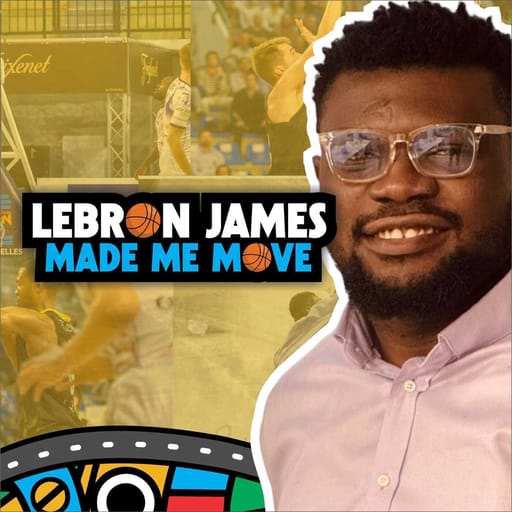
Transcript 0:00 Soccer player studying medicine, but within the next 12, 18 months, he ends up in the States playing college basketball under a scholarship. Mu's story is a really interesting one, to be honest. 0:15 I just couldn't stop laughing because if you're Nigerian and you know a Nigerian father and you're studying medicines in university and you tell your Nigerian father you want to go play sport and abandon your, your medical course, you'll, you know what you're gonna get. 0:30 But, but he did it. Enjoy. [outro jingle] Welcome, man. Like, I know it's taken us a while to get this going, but I, I mean, I'm so excited to do this with you. 0:46 Well, you know, I'm just gonna go back to, um, talk about, you know, it was your LinkedIn post that that's how I found you. Your post where you talked about when you left Nigeria like eight years ago to play basketball. 0:57 Yeah. Yeah. What was going through your mind at that point in time? I mean, I saw you say you're a soccer kid who they convinced that you could play basketball. 1:04 Uh, honestly, um, I don't know what was going through my mind, but I was, I was actually in the p-period of writing your WAEC-NECO. Yeah. That I'm getting into. 1:16 I had just gotten admission to do medicine and surgery in Imo State University, IMSU. Wait. [laughs] I had an admission to do medicine and surg... In fact, I did, uh, I did a year in IMSU, and I was a course rep. 1:35 So it was this course I, I was-- it was SS2. I was transitioning between my SS2 and doing a course in IMSU 'cause I wrote WAEC at SS2. So I had this friend called Robert and Alex. So they had-- they were into basketball. 1:52 They were the taller kids. I mean, I've tried it in secondary school. I, I tried Milo, but you know, soccer is my first love. Yeah. And so, and they were like, "Hey, come with me." Dan Anyiam Stadium actually. 2:04 They were like, "Come with us to, to Dan Anyiam. Uh, we have a scout that is coming in, and if you make it, he's going to take you to something called the AGK camp." 2:14 AGK camp is the biggest, like, Ejike Ugboaja camp is the biggest basketball camp. And I was like, "Well, I can come watch you guys, but man, basketball is not for me." Yeah. 2:23 My head is still bursting about, you know, medicine and surgery, IMSU. It's a different level once you get admission into medicine and surgery. Yeah, exactly. And, you know- You know, Nigeria. 2:35 [laughs] You know, my dad is also like a big-time scholar, and so he was like... It is something that gave him pride. Like, this kid, at least I can get something out of education from him. 2:48 So I go to the basketball court that day with them, and they were playing. And me, I'm a hustler. I'm always looking for something to do, so... 2:59 And I usually sell things a lot, whether it's iPod, phones, all this st-stuff. So I was like, you know, selling on the side. And at some point I got bored with their basketball 'cause I thought it was just a easy sport. 3:13 So I saw kids playing soccer. I joined them and was playing soccer, but I didn't know one of the scouts, Mr. Tony from California, he was looking at me. So he, after he walked up to me and say, "Why do you play soccer?" 3:27 I was like, "Why wouldn't I play?" And he was like, "I think you should play basketball." I was like, "There's no money in basketball. Tell me one Nigerian that has made it with basketball." 3:39 And then he started mentioning names. I was like, "How much do they make as professionals a week?" 'Cause you're so used to watching Chelsea, all these- Yeah. And the crazy part that time, Iheanacho- Yes... 3:52 he, he was, he's from my hometown. He's from my state in Imo State, and he played in Dan Anyiam. We call him Lefty when we played on the same academy. 4:01 So Lefty went to national team and all these people were in national team. Like, the guy that played basketball I know was going to national team. So I was like, "These guys left basketball to go play national team. 4:13 Now they're making millions of naira a week." And I was like, "Man," you know, I was like... We, we talked for a while and then he was like, "I think you should come. 4:22 When you come, they're going to pay for your schooling, and you get a scholar- you can end up playing professionally too." I was like, "Honestly, this thing is sounding good, but you have to first convince my dad." 4:36 And so we went home. [coughs] I went home. I didn't even talk about it with my parents 'cause I knew it would be like- Yeah... dead on arrival. My dad wouldn't even listen. 4:46 Sports, my elder brothers tried sports, played soccer, and my dad didn't even listen to them when they tried to go to Holland to continue playing. My dad told them, "Register in FUTO." 4:59 [laughs] Elect-electrical engi- electri-electric- I know your kind of dad. Like, gosh. He was like, "IMSU and FUTO." In fact, one of my brother, he played for two admissions when he was going to IMSU and FUTO. 5:14 He was doing library information science here and information technology in FUTO and IMSU at the same time. 5:21 Anything going to do sports or music, even my sister that tried theater arts, that's what she went to school for, brought her back to go learn urban development in UNIPORT. He was like, "We will not act. 5:34 You, we're not going to make anything out of this. Go study economics." So it's like I knew it wasn't going to fly, so I ended it. So, um, one of my friends, Alex, like met with Mr. Tony, so brought him to my house. 5:48 So I just came back from school one of those days, and the man was sitting in my house with my mom, and I was like, "Oh, there's fire on the mountain here." 5:56 And my mom was like, "This man told us like you're very skilled in basketball." Me that I'm, I don't know my right or my left [laughs] in basketball.And he, he's, he thinks you have a future in America. 6:08 And me, I started laughing at the man. I said, "This is not going to work." I was like, "It's not gonna work." And my mom was like, "Well, we have to wait for your dad." 6:19 Like I predicted, my dad came out and was like, shut the thing down right away. I was like, "No, no, no, no, no, no, no." My dad was like one of those men. So Mr. Tony kept coming around 'cause he was in Nigeria. 6:30 He was running different camps. He, he kept talking to me and, and I started gaining interest. Then he sent me a, a video, a game to watch on DSTV then, Super Sport seven, I can't forget. 6:42 It was at 3:00 AM, and I watched LeBron James play. And that day I was like, "This is what I want to do with my life." Are you serious? This is what I want to do with my life. And so I started working towards it. 6:58 I got a trainer, I got friends that started training me, and I told Mr. Tony, "Go ahead and apply for the admission." 'Cause usually in Nigeria, the way it works is, um, you want to go to high school first. 7:13 But I already had an international passport, and I already applied to schools for medicine and surgery already outside the country. So I was like, I can't go to prep school or high school. I have... It has to be college. 7:29 And so Mr. Tony applied to a college and I got an admission. They offered me some scholarship money. I was able to play basketball. 7:38 But then the problem is how do I tell my father that I had a visa appointment to go to, and I was still what? I was 17, about to turn 18. 7:48 I needed an adult to go to the embassy, or else I had to wait till I was 18 to go by myself. You know, Mr. 7:56 Tony was like, "Well, first of all, your dad has to sign this paper that gives us permission to continue working with you so that we don't get in trouble." 8:06 And I told my dad the first time, he was like, "If you tell me about this thing again, I will kick you out of this house, then you can really go play your basketball." So, you know, I- Gosh... 8:17 I'm, I'm the tech guy at home, so I handle all my parents' phones. I'm the one that helps them send text message, download WhatsApp, anything. So I bought this SIM card. 8:28 My dad used to have one of those Techno phone with four SIM cards. So I put one of the SIM cards in- His phone. I put one of my SIM cards in his phone and texted Mr. Tony and said, "You know, everything is right. 8:42 Keep going. You have my full permission now." And then I even created an email with his name, which till today he still laughs about it. 8:51 And I sent an official email, 'cause then my dad used to go to like a computer place. He sent us to computer school. I'm the one that used to type up my dad's email. 9:02 So I sent out this email and there was money that was supposed to be paid, about like 115,000 at that time. I didn't have it. I was a broke high school kid. 9:13 Then I went to my mom and I, you know, eventually told her what I did. Told her I need 115K. You know moms- Yeah. They'll do it... when you beg, beg, clean the, clean the house, wash the... I used to wake up at 5:00 AM. 9:25 We had like four cars then. I would wash everything, polish and iron their sh- shoes and clothes. So I was the good kid in the house. So my mom, uh, fronted me the 115K. I sent it to Mr. 9:38 Tony, forged my dad's signature on the document, sent it back to him, and that process started. So when the problem came was when my, when the visa, the... I was, got invited to, for, for the visa. 9:51 How can I explain to my dad I'm going to be away from home for a week? So I had to go tell him, but my strategy was going to my mom and I was like, "Hey, you gotta use your bedroom voice to get, get the ground fertile. 10:07 I know he's going to shout for a week, but then he'll come around." And so it was exactly what happened. 10:13 He came around, then I started explaining to him like, "Hey, in America, when you go to play sports, you have to also be good academically. You have to maintain a 2.5 GPA to a 3.- 3.5 GPA to even play the sport. 10:27 So they will even force me to go to school. It's a decent education." And so my dad was not convinced. 10:34 But the funny part, my dad was going to America in three days from when we were having this conversation to, for a meeting or something. 10:42 So when he went to America, so he was telling a couple of his friends like, "Hey, this is what my..." And they were the one was like, "Hey, don't stop him, oh. Allow him to come. 10:52 Like, he gets the best education and you don't pay for it," and all. So they like gingered him. Yeah. And one of my uncles, which I love him so much, Uncle Francis, wherever he is, I still respect him to this day. 11:05 He was the first uncle that even told me about sports. And he would tell me something like, "Hey, if you pass your WAEC, if you have seven A's in WAEC, I will give you $1,000." 11:17 So when my dad was going in, my dad was also telling my uncle I had seven A's in WAEC, but also telling him that I, I'm now trying to leave medicine and surgery to come to America to play basketball, and he doesn't know what I w- I was going to do in school. 11:31 My uncle was like, "Please leave him." So my uncle gave that $1,000 and my dad came back. We had a new discussion. He was like, "Okay, I'm going to let you go. 11:42 We're going to go to the visa interview together, but we need to choose a course that makes sense." And we ended up saying I was going to do engineering, which didn't even work out. [laughs] But we went to the embassy. 11:57 Man, they bounced me the first time in Lagos Embassy, and the school resent an, uh, another, um, a I-20, and then we went to Abuja Embassy. Uh, now the school wrote a let- letter to the embassy. 12:10 So the embassy, I got my visa. I went the first time, I felt like dying 'cause when we went it was Christmas. I had already told my friends, "You will not see me again. 12:20 I'm gone."Before Japa became Japa, I was like, "I'm Japaring." And yeah, it was funny 'cause I went in December, they d- denied me. Then I went again in, like, May, and I finally got the- [chuckles]... visa. And 12:39 my dad is very, ah, very business-oriented young man. Mm. He's, he's about 5'2". My mom is about 6 foot. And, you know, we sat down, he told me like, "You know, here is the paper. Sign this for me. 12:56 As long as you're maintaining 3.5 GPA, you can go ahead and play whatever you want to play. And after four years, you need to send me a certificate, BSc. It's my own. 13:10 If you decide to keep going to school, it's your business." So that was literally my immigrant journey here. So, um, I, I came to... 13:19 I remember landing in Houston, um, Houston Airport and connected, joined my connecting flight to LAX Airport. Man, it was a different world. I was cold, but it was summer, but I was real cold. 13:34 I came with only a school bag 'cause I was listening to my friends that went to high school, and they were telling me, "You don't have to buy clothes. It's fine. They will give you clothes." 13:44 But I forgot they came here as minors, so they had host parents- Mm... that literally did shopping for them so they could come with a school bag. 13:53 So I came with a school bag, and I came, I was like, "Man, I have to buy clothes. It's cold out here." [chuckles] Mm. But, but I was with Mr. Tony. I was with Mr. 14:02 Tony for six months in California before I decided to chart my own part because the school, the scholarship they gave me was so small. What I was supposed to be paying, my decent earning parents couldn't afford it. So, 14:18 um, I went ahead and started making contacts. Then I, I found a host family from Iowa that, you know, they called me and was like, "Hey, do you wanna come spend Christmas?" 14:29 And I went to spend Christmas, and they loved me, I loved them, and they were like, "Hey, come live with, with us. We're going to find you a school here." 14:36 Like, God literally did-- was working overtime for me 'cause I was wondering like, "Man, how was I going to pay the next semester school fees and stuff like that?" Yeah. So they brought me over. 14:46 They talked to a coach at a college, a junior college there, and the coach was like, "I'll take him. I'll give him a scholarship." And I came. I moved from California to Iowa. You know, the first time I was moving, 15:00 I-- the first time I came to Iowa, I thought it was California. The weather is decent. I was we- I was dressing like California boy. Mm. Tank top and short. [chuckles] Mm. Mm. When I came out from St. 15:13 Louis, Missouri Airport, the cold that hit me. [laughs] We looked for a Patagonia store in the airport. We bought the most expensive jacket I still own till today. [chuckles] Oh. 15:26 [chuckles] And that, it was, that thing was about 100 and, 135 bucks. We bought it, and that was how I moved from California, and that was how my, really how my journey in America started 'cause it was like... 15:40 'Cause when I was with Mr. Tony, he was very protective. Like, he wouldn't let me go out. I didn't even experience what it felt like being in California. 15:50 It was like school, class, basketball practice, back home, training, back home. I was literally living the pro athlete lifestyle, but I was just a young kid. 15:59 But when I get, came to Minnesota, uh, to Iowa, I got a little free rein to explore what life in America is like, you know. Like the immigration process, start learning all those processes. 16:12 And that was my little journey from Nigeria. From a soccer kid, and I pretty much had to learn basketball here in America. My first day at basketball practice here, oof. You know, we play outside in Nigeria. Yeah. 16:27 And we play three on three. I don't know what full court is. [chuckles] And you know, we play so super aggressively. You don't know all the rules. 16:39 Man, all these guys were speaking, I felt like they were speaking in tongues in practice. But what just helped me was I was so athletic and fast, so I could just run, and I could jump, I could dunk. 16:53 That was one thing I could do. And so, man, by the time I ran the court, I realized that the court we build in Africa is small compared to the court... 17:03 [chuckles] By the time I ran, like, five times back, I started breathing so hard. I was so out of shape. The coaches-- I was puking. And then they took me to the weight room, 'cause when I came I was 165 pounds. 17:19 They took me to the... I was 6, 6'7", 165 pounds. I was very lanky. E- even they had a name for me in Nigeria. They call me Swagger Stick. Like- Mm. 17:28 [chuckles] Like, anybody that calls me that name, I know he knows me right from- Mm... old town days. 17:39 And so the first time I went to the gym, you know, they put, like, weight for me to push, and I was like, "I don't need this thing. I'm already naturally strong." 17:49 Man, I c- I was struggling pushing the weight, and it was, it was, it was a surreal moment for me. But also, I'm very thankful that I got that opportunity because not everybody gets that opportunity. 18:03 And looking at people doing medicine and surgery now in Nigeria, I was like, if I was still doing that course, uh, I would be going into my 10th year now, and it's like 10 years course in Nigeria, and I don't even know where my future would be going to. 18:16 So I thank God for that, um, that experience. It was a good experience. It's what brought me here to America. 18:24 A kid that didn't play basketballAt 18, coming to America, learning the game, playing and learning to being humble to learn and getting to play on the big stages. It was, it was a life... 18:38 It was, it was a journey that changed my mindset in life. That is some story. You know. This, this is my immigrant story. 18:55 Like, but what were the biggest things you struggled with, like, while you were there? Like, while you were starting out, like, what were the biggest things you struggled with? So food was big. I struggled with food. 19:08 I struggled with kids in, in, in Nigeria, especially in the Igbo land. So at night, the guys, you guys meet at the, the street, somewhere in the street, either you play soccer together and it's like there's nothing like 19:26 the whole proce- official like... Like people-- my friends can just show up to my house whenever they want. But now I have to like tell people ahead of time, "Are you coming? Can I come to visit you?" 19:39 Like, it's so individualistic and it took me a long time to adjust to that. A- and just even learning like how to interact with people, what is offensive. 19:52 Like, I would call somebody fat and they were like, "No, you can't say that." 'Cause I was so used to like, you know... I used to be a, uh, uh, like a little jack star, like jet star when I was growing up. 20:05 I would make fun of people and so, you know, I was so used to like poking fun at people. And so I would, so I would say things and they would be like, "No, you can't say that." And so the food, 20:17 the individualistic culture, how sensitive they, they are, and just their weather was very tough for me to adapt to. 20:31 Those were the things I struggled with from a culture- cultural shock. And how fast they spoke. I felt like, oh, they spoke faster. And how I knew that my English wasn't... 20:44 I still still struggle with the English there 'cause I have an accent. It's something I told them like, "I'm never going to lose my African accent. It's what makes me Nigerian. I'm not losing it. 20:55 If you can't hear me, forget about it." And so it's like people complaining like, "Huh? What'd you say? Come again." I was like, "I know you hear me. You're just not trying to." 21:06 And them not being able to pronounce my name was another ca- I was like, "It's the easiest name. It's Munachiso." And they started calling me Big Moo. And I was like, "I know you guys can try." 21:20 But then I figured like, I'm not gonna keep fighting with these people. Yeah. I should just, um, you know, if you're in Rome, you act like the Romans and adapt. And so that's, that's basically what I did. But 21:34 it was a great experience overall. It was also, it was hard at first 'cause I was alone and it, it could get, uh, some days it got really depressing, but at that time I didn't even know what depression or depressing was. 21:48 I was just like, "Oh, this place is so boring." But it was getting to my head and I was like, I needed to get to a place where I can see more Nigerians or more Africans. 21:58 The first time I was with m- around more Africans that understood the struggle, ah, it was a different ball game. It was such a different ball game for me. But yeah, that was my experience a little bit. 22:17 Damn. Damn. Like, and to think you did all this, like when you were like 17, like... Now, like with the basketball, did you still play it like or like when did you stop? 22:31 Like, 'cause I know, I think you played, played it for a bit. Yeah, I played it for a bit. I played, uh, all through college and then went on to-- I went pro in 2019 after graduating and, um, 22:44 and then went to France, went to Sweden, went to Portugal, went to Spain, went to Ukraine, and decided to retire. 22:56 So I got to travel the world pretty much a little bit, in different cities in the world, experience different cultures, um, while getting paid. So 23:08 I played it to that point where, you know, I th- I think one of the things that, you know, made me call it quits, one was injury, one was when I started, I joined my, um, childhood friend, um, to start building City. 23:23 One was also trying to be present in my two daughters' life 'cause I realized that, um, you know, with the culture in America, like 23:33 kids need their father to play a vital role, especially in this, um, behavioral forming years. And so, um, I decided to come back and call it quits. 23:45 But I sometimes I still think I didn't call it quits on my own terms because I was injured and the whole immigration process was going on for me to get my residency and citizenship and all that stuff. 23:57 So I was like, I don't want to jeopardize this. And so, yeah, I called it quits and then, you know, went on to start building City with my, my childhood friend who is doing absolutely great right now. 24:11 Um, he also founded another startup called DineSoft, which is a restaurant reservation platform for Africa, and they're actually going to be in a competition tomorrow. 24:21 Martin Sudotai, one of the most creative minds I've seen out there. Akwa Ibom guy, I told you. They're very creativeOh, God. 24:32 Like, you know, I think I should end the story here because I feel like that is the story, to be honest. [chuckles] Yeah, that's the story. But man, you are something. 24:40 Like, I swear, like, I'm just thinking about the things you did with your... I'm just-- with your dad, like, to get your dad's approval and stuff. You were something. 24:49 I was, I was the black sheep of the family, so it's expected I would do black sheep stuff. 24:55 So e-e-even when you tell the story to anybody that knows me, it's like, it sounds like something he would do, 'cause I'm the one that would... tested my dad's patience the most. I tested that man's patience. 25:08 But now we're like, now that I'm mature and grown, we've become like best friends. Like, going back for my mom's funeral, he was like my right-hand man. I was his right-hand man. 25:18 We spent time, you know, learning the histories of, you know, my town. Like, so, like... And we told these stories again and he was laughing and it, it's, it's like it brings back good memories for me. 25:32 I mean, you gotta take the risk. Yeah. If I didn't take the risk, I would be stuck in Nigeria with how the economy is going. Yeah. Yeah. Um, but it also, like, I took the risks. 25:43 It's, it exposed me to a lot of innovations, a lot of things, a lot of people, network. And now, um, I'm able to start shifting my mindset, like, how can we help the Nigerian economy grow from a diaspora level? And so 25:59 it's the risk-taking me. I've taken so many risks in this life, so some of them I, I advise people not to try, but sometimes you have to take it. [chuckles] No, but like, the fact that like, look, like, once you... 26:12 I feel like once you decide to immigrate, like, that in itself is a risk. Yes. It's- You don't know what's gonna happen. Like- It's-... the journey itself is, you don't know what it is. 26:20 Like, you're just going on a long journey. You don't know where it's gonna end. It's the most insane journey you can take. Many years. Man, I, I was, uh, I was thinking once I get to America, money. 26:31 [chuckles] Like, I was like, "Find one land in the village for me to buy and build." Like, I thought once you get here, money is flowing everywhere. Oh, God. 26:43 [laughs] And you know, like, I, you know, it's like start thinking, "Once I get here, money," like... And, uh, what else did I think? I was thinking like, you know, what I was watching in TV- Yeah... 26:57 was the same things in America. [chuckles] Like, the first time I saw, like, man, we have like inner cities here that are just as messed up as what we have back home. Yeah. 27:09 I was like, "This is not the America they sold me or this is-" [laughs] "Whoever sold me this American dream, we have to come back and reevaluate it." 27:18 But, um, it was some of the things that I had to change my thinking process. And you know, I don't know, we Igbos, we have this pride that we will make it. Yeah. So I was telling my... 27:30 You know, I was telling my mom, my sibling, "Don't worry, let me go to America, stay six to nine months." But when I came, came I realized I couldn't work. 27:41 If I wanted to work, I had to work in the school, and everybody was applying for the same job. [chuckles] You know this thing they say about, um, how... I think someone said it to me where, 27:54 the thing about immigrating is that you immigrate and you sort of learn that there is what you see on the media- Yeah... and then there's the, there's living in the country itself. Mm-hmm. They are two different things. 28:09 Like, you know, and each system has their own advantages and disadvantages, but you start learning to appreciate the good parts of your country more because you're like, 28:21 yeah, maybe one country is better than the other, but it doesn't mean that everything is all rosy. Just one country sells itself much better than the other. That's the story. Man, I would... 28:29 You know, this is what I tell people. I would take making 400 to 500K a month in Nigeria than coming here and making, you know, three to four grand a month 'cause everything you make, you, you work for the government. 28:46 It's like the bills coming out. [chuckles] You're paying bills back to back to... [chuckles] I was talking to my friend the other day, he was like, he was telling me, 28:58 "Mo, this America you told me about is not it, though. Every time I work- [laughs]... it's like these people are waiting for me to collect my paycheck. They are billing me back to back to back." 29:10 He's like, "I cannot even have saving. Me that used to have saving in Nigeria." I was like, "The problem is when you were in Nigeria, at least if you don't have a place to live, you can go back to your parents' house." 29:22 Yes. Yeah. But you don't have that cushion here. And so it's, it's something that we began to realize and learn and, and adapt. And it, it's good 'cause now, um, you grow up. Yes. 29:36 And for me it was very easy to adapt 'cause I went to a boarding school. So in boarding school, I went to Nigerian Navy, uh, secondary school. In boarding school I had to adapt. 29:46 When provision finish and visiting day is not coming anytime soon, you start learning- Just-... how to sell contrabands. I was selling lollipop. 29:55 Till today everybody in my secondary school knew me as the guy that sells lollipop, superstar chewing gum- [laughs]... and ca- and cabin biscuit. Even to the point I started selling ironing. 30:07 To borrow my iron, you have to pay some money, 'cause if you have iron in those days, it was very high commodity. Yeah. We started learning negotiation skills in boarding school. 30:18 Like, "Hey, you want my indomie, I get your fried rice and chicken on Sunday evening." Negotiation was... So I think boarding school helped me... easily adapt here because I saw it as another boarding school. 30:34 I was going to be away from my parents for two years. While boarding school you are away for two months or three months, and then you come back home, you spend a month. 30:42 But here I'm away for three or two years, come back, spend a month or three weeks and go back. Sometimes it takes five years to see them. Yeah. The last time I went back, it took a long time. But, um, 30:54 yeah, it's, it changes your mindset and it's good and it's bad. Was that- Yeah... the same thing you experienced on your end? Yeah. Yeah. Same here. Like you, you literally morph. Like you morph. 31:08 And here's the other thing that I struggle with a bit, is that you find out that you're not fully... So let me use myself as example. You're not fully Canadian, neither are you fully Nigerian anymore. Yeah. 31:19 So you're just somewhere in between. So when you go back to Nigeria, there are some things that you j- you can do and some things that you struggle to adjust to again. Mm-hmm. 31:28 Even when you come back to Canada here, you don't, you, you just sort of know you're not fully Canadian. I mean, you're Canadian, yes. 31:34 You're like, you've been here for a while, but you're like, "Nah, I'm not f- I'm, I'm still not exactly..." I, like, I wouldn't call myself... I, I tell people that I'm Nig- I'm Nigerian-Canadian, you know? 31:44 I- My kids are Canadian-Nigerian maybe. [chuckles] Yeah. The, the, the true thing is when I went to Nigeria, what really pissed me off a lot was the entitlement, and I can have a temper. 31:57 [chuckles] So a fun story for you. When I went back for my mom's funeral, we tried to get a flight for me to go back to Lagos, and we, we couldn't get, so we had to use God Is Good or GIU, whatever it is. So I paid... 32:12 I'm tall, I'm six foot eight or six foot nine. I'm really tall, so I paid for like three seats in their Sienna car. Even I- if I had, if I... 32:22 It was just because my dad was like, "Don't take the whole car," 'cause I like my comfort. So I paid for three seats and I come and I have like three luggages and they were like, "You have to pay for extra luggage." 32:35 I was like, "I literally paid for three seat. What are you talking about extra luggage? Each seat gets a luggage." 32:43 No, I got in a, uh, the m-manager assaulted me so bad that I got so mad, 'cause this is a manager that is five foot four. I, I can pick him up like... And so, so he, he... I literally re- 32:59 like, like I, I was like, "I think you're thinking I'm American, that's why you're beginning to treat me anyhow." Like I switched to my Pidgin. I said, "Listen. Oh, boy, wetin dey worry you? You dey craze?" 33:11 Eh, you know, he went to call... 'Cause you know those tax they have like- Yeah. All these tax and stuff... with the police, with the police. Mm-hmm. 33:19 So he called the police to come arrest me so that I can stay in the cell, they can take some money. And when I was going, I started laughing. 33:25 I said, "Ah, this guy just don't know I'm Alaye o, that I lived, I grew up in this town. That one he knows I know." 33:33 So when we got there, I called my, I called my, uh, brother-in-law, my sister's husband, that is like a commissioner of police. 33:40 I called him, I say, "Your boys came and carried me o when I was jeje sitting on my own trying to go back to Lagos. Now they want me to pay 150K as bail money." He say, "What did you do?" I explained the whole situation. 33:54 He said, "Don't worry. Give me two, two seconds." Now I was sitting in that police counter. I even balance well. Now the police guy came and was like, "Oga, just forgive everything. Carry your bag. 34:07 Let's be going so that you join the car and go to Lag-" I said, "No, I'm not leaving here till your DPO comes." He say... They begged me that day. Oh. 34:16 And when I came out, I told the driver, "Don't look because I'm dressing this way, you think I don't still know... have Nigeria." 34:22 So it's something that I noticed, like when you come back to Nigeria, they no longer treat you like a full-blooded Nigerian. Yeah. Like people grow up there. Like me that grew up in the town that I... 34:33 Like I told you, I was a black sheep in the town. [chuckles] I was a black sheep. Me. Even the town, some of the towns recognize me and say, "Ah, you don tell we we never see you. Where you dey since?" 34:46 I was like, "This guy didn't know I was hustling this town before I left." [chuckles] Because America now modernized us and gave us a new orientation, and we started seeing life differently. 34:59 Sometimes it comes out, though. It's like why- Mm. Even here in America, I don't know for you, Canada, sometimes people do some things to you be like you laugh and say, "Ah, if only these people know." Knew. 35:11 [chuckles] And then you suppress. But I think one of the things I really love is once I get to that Lagos airport or Abuja airport, that sense of I'm home that you have- Yeah... 35:26 is different from the way you, like, walk- Yeah. Like, walk like you're about to get in trouble in America. [chuckles] Yeah. Like that sense of like, I'm home. 35:37 But I don't know if we have it anymore with this whole insecurity issues in Nigeria. [chuckles] I mean, like, yeah, it's... The thing is that, you know, now when you go back now, like I don't know how you went back. 35:45 Like from like, for my dad's funeral when I went back, like I, I could only stay... I didn't even sleep in my village. I went that day with security, left that same day. Like it's just so strange. 35:55 Me and my, me and my village elders and uncles, they like, uh, ah, they c- they call me Ìṣìnyírànwó. [laughs] They, they... After my mom's burial, they knew I was stubborn. 36:13 They were like, they were... 'Cause this boy, this, this... Because my dad's name is Benga. They would be like, "Benga son is Ìṣìnyírànwó." The head that refused to die. I- Like you, you, you stayed there for like days? 36:26 I, I stayed. I w- I, I made sure my mom was buried according to the custom, culture, everything. 36:32 So it took days.I mean, my, also my mom was a philanthropist, so we had people flying in from different parts of the world or, or the country coming for the burial. 36:42 So it was, I, uh, even when they were killing the cow, I was there with them. I was like, "No, this one is for my age grade." [laughs] So 36:53 they were, they were like, "How is this American boy, how do you know the culture of the land?" I said, "Ah, it's me o." 37:01 But I still, I, I think al- it's different for different villages, 'cause my village is very small, or it's a very small village in, uh, in a big local government. 37:10 So I know most of the kids and they know my dad built a couple of schools and stuff there. So the village people will protect us first before- Yeah... anything happen. 37:21 So I was more scared when I was in Owerri than when I was in my village. I can imagine. I can imagine. But it's, it's the, it's the process. But me, even when I went to Nigeria, I was taking public transport. 37:36 Of course, man. [laughs] I was going, I was traveling to Abuja, I would hire a Sienna 'cause, uh, it's, I have phobia for the flights in Nigeria. 37:46 After what happened with Sosoliso, where I lost a couple of my friends, close friends, till today to fly in Nigeria is a big phobia for me. 37:56 [laughs] Even if I have the money, I would rather charter a whole Sienna and they drive me to my destination. 38:03 The only problem I'll face is that I have to, if you pay 250 Nai- 1,000 Naira for a, a car, you have to budget maybe extra 50,000 Naira for the road. [laughs] So, uh, it, it was-- I think it's a great experience, but 38:20 it's just also like there are some certain things you can't tolerate anymore when you've lived in America and come back. It's like- Yeah... you have respect f- for the value of the money. 38:31 Like every one Naira you make sure it's being accounted for. Yeah. Yeah. Yeah. Oh, man, this has been good. Let me, like, this is such a beautiful story. Let me end it here. [laughs] Such a really good... 38:47 Well, thank you so much, bro. Well, like, let me, let me call you like the Americans. Thank you so much, Big Mo. [laughs] No, no, no, no. I'm not big anymore. 38:56 Since I left basketball, I've been becoming slimmer and slimmer. Yeah. You lose some of the muscle you bulked up during that, during those times. Yeah. Now we're trying to fight the dad bod. Ah. 39:10 [laughs] We didn't [laughs] we didn't used to have it, now you're having it. So every morning you look at yourself in the mirror, you say, "Ah, where has Mo gone? Where has the real Mo gone?" [laughs] I feel you, man. 39:21 I feel you. I feel- But it's, it's a process. The, you know, it shows growth. That's what I see. Yeah. Yeah. As usual, thank you so much for listening to this episode. 39:30 I really appreciate that you got to this point at the end of the podcast. If you enjoyed this, please like, share, you know, follow us on Substack, share with someone whom I find this useful. 39:41 And with that, have a beautiful day. Thank you. [outro jingle]