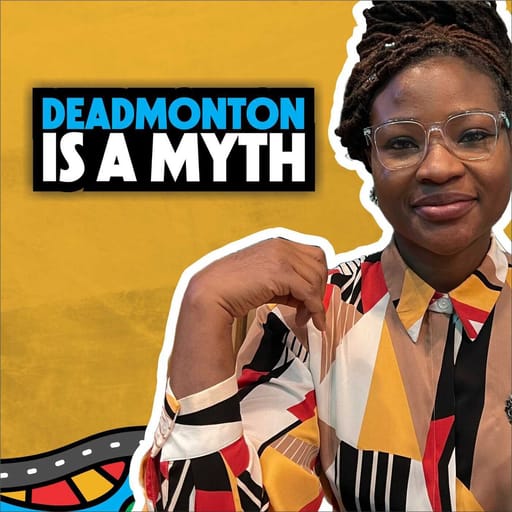
Transcript 0:00 For me, the most interesting thing I got from this conversation with Lola was Deadmonton doesn't exist. 0:08 I mean, well, it was more like confirming what I started suspecting once I started following her Instagram page, because 0:16 when, and I, I mentioned this in the when, when I was there in our conversation, is that when I was planning to move to Alberta, we just sort of scratched off Edmonton as Deadmonton. Nothing happened there. 0:28 But, you know, what we started noticing was every single act, like that's an artist or star that came to Cal- to Alberta, it happened in Edmonton. You know, everyone went to Edmonton. No one came to Calgary. 0:43 You know, and it's still frustrating. I mean, well, I'm happy Johnny Drille is coming to Calgary this year, but still, that's like one out of ten. But I'll let Lola explain, tell you all, Deadmonton doesn't exist. 0:57 It's sometimes shocking that I still hear some people refer to Edmonton as Deadmonton, maybe because they've been part of these festivals for so long, and then they are looking to something new. 1:08 But I can assure you that every year there's always something new to enjoy about the festival. And so for everyone who has heard that Edmonton is in quotes "dead," let me tell you, it is not dead. 1:20 [laughs] Welcome. 1:30 [laughs] You know, I'm excited to do this with you because I get the sense that you're shy, but I feel like shy people make the best convers- conversations. But you know what? Welcome to the Newcomers Podcast, Lola. 1:42 Thank you. Really happy to have you here, and I'm just gonna get straight into it with one question I've, I've been thinking about since the first day I came across your, um, your Instagram account. 1:54 When I was moving to Alberta from Ottawa, Ontario, so we'd, so we know we had friends in Edmonton. We didn't have... 2:02 We had some friends in Calgary though, but I mean, we had some really close friends in Edmonton, had some really close friends in Calgary. 2:08 And then f- we talked, we said at some point, me and May said, "Uh, maybe we should move to Edmonton." And they go like, "No, Edmonton is called Deadmonton." So we moved to Calgary, 2:22 and I've kept that bias for a long time. I mean, I've come to, uh, I've come to, I've come to Deadmonton a couple of times, two, three times, but I've kept that bias. And then I come across your page, 2:34 and after one week I go like, "Wait." Like, so, so it was so bad that I first had to literally, I, I watched it a couple, and I'm like, "Wait, wait." I started scrolling through your, your older posts, and I'm like, 2:47 "This place isn't actually that dead." Like, it's not dead. Like, so why does it have that sort of image to it? [laughs] Uh, I've also heard that. 3:00 You see, uh, let me say first, thank you for having me in your space today. Uh- Cheers. When I was moving to Edmonton, I didn't even consider if they had a number of activities. 3:11 I only came here because I had, like, a close friend living here. Mm-hmm. So all of those were secondary. It wasn't until I moved here that I also heard that Edmonton was being referred to as Deadmonton. And 3:25 then I started to wonder, I still do not know where that stemmed from, but of course things changed for me over the years. And I see Edmonton is actually called the Festival City 3:37 because they have a number of festivals all year round, and I mean all year round. So even when it's freezing subzero, we have Edmontonians padding up [laughs] Are you serious? Laying up. Yes. 3:52 I tell you, we have some, um, winter festivals that are constant, so every year you'd have Silver Skate festivals. That's, like, the longest running winter festival, and I'm going to that tomorrow. 4:04 [laughs] They have quite a number of festivals that people would always turn out for, so it's sometimes shocking that I still hear some people refer to Edmonton as Deadmonton, maybe because they've been part of these festivals for so long, and then they are looking to something new. 4:20 But I can assure you that every year there's always something new to enjoy about the festival. So, uh, um, [laughs] 4:29 it's, it's just nice, uh, to have a lot of these events happening and for immigrants who've also heard this, uh, from other people maybe doing their research, because before you immigrate, you would always want to research, uh, where is the best place to go to in terms of cost and in terms of other things as well, where you can adapt to easily. 4:48 And so for everyone who has heard that Edmonton is in quotes "dead," let me tell you, it is not dead. [laughs] You can have lots of fun here, a whole lot of fun. The community is growing as well. 5:02 We have a big Nigerian community, and you can always integrate in the quickest way possible. Mm-hmm. You know, I, I, I, I, I agree. I agree. Because, like, 5:15 so I have this friend who's moving to Canada, and so he's moving to Edmonton. Now, previously, if someone told me that they were moving to Edmonton, I'd be like, "Yeah, it's called Deadmonton, though, but you can go." 5:26 You know, that sort of thing. But, like, for the first time he was-- I'm like, "Yeah, yeah, sure, sure. You, you'll have fun. You're two hours, you're two hours away from me. I can always come down to see you." Mm-hmm. 5:36 And, uh, I was like, "I have a friend who runs a Instagram page that you could just go and check and see what's happening there," to be honest, because I ha- I carried that bi- I've been, I've lived in Calgary for two years now. 5:45 I carried that bias for the better part of those two years, to be honest. So thank you for your page. Now let's kind of go back to the beginning. Now, you did all the research. You had, you had a friend. 6:00 I mean, was it one friend, two friends, or just that one friend?One friend, well, she's a dear friend. She's my closest friend. We've been friends for over 20 years. Cool. 6:12 So now, I mean, that, that's, that's some community somehow in some way, but still, like, moving to a new place is a lot. How did that first night, first day, first week feel for you at that point in time? 6:27 [chuckles] If I tell you the date we left Nigeria in 2018, you will say I'm not a patriotic Nigerian. October 1st. We left [laughs] Yes, you're not patriotic. You are not patriotic. 6:45 On Independence Day, y- wait, wait, wait. You know, you know the irony of that story is that, so you can look at it this way. You can say you're not patriotic. 6:52 You can also say, "I got my independence from Nigeria on Independence Day." Like that's [laughs] See, that's another way to look at it. Are you serious? 7:01 We left Nigeria October 1st, 2018, arrived in Edmonton October 2nd, 2018, and I honestly cannot remember what the first night felt like, but the first week there was snow in October. 7:19 It was, it was my first time seeing snow [laughs] and it was-- it just felt different, you know, being somewhere so far away. 7:31 I mean, for the first week, uh, I was still missing my family, uh, still trying to communicate every day with my siblings, but then I was also trying to enjoy everything that was around me. It was all new. 7:46 I'd never seen snow. I'd never been on, like, their train before. Uh, I mean, it was really, really a lot of new things for me, so trying to settle. 7:59 We were not living in our own apartment then, so my friend was, uh, gracious enough to host my family and I. 8:05 So moving around was still pretty easier on us because they would volunteer to drop us, uh, for certain things, and then we could just find our way back home. So a lot of Ubering, [chuckles] paying for Uber, 8:19 uh, because I still did not know how to use the bus system. 8:23 And, um, I think the first week as well, because, you know, when you're traveling, there would always be that one person in Nigeria who would say, "I know someone in Edmonton or someone here. 8:33 Please help me take this along." Yeah. So someone gave me food stuff to help her deliver to someone who lives in Canada, but not in Edmonton, so I had to go find, like, post office to post it to the person. 8:46 And I recall that when I was going, uh, because my friend had gone to work, so I was trying to take the bus on my own. I think that was the first time that I was going to take the bus on my own. 8:55 I was walking on the road, and then I crossed to the other side, but it was not a pedestrian walkway. 9:03 It was-- I was walking on the grass, and I think someone was coming, and then he was honking and giving me cue to, like, just walk across back to the other side where I was coming from, you know, so I could walk on the [chuckles] pathway rather than just walking on the grass. 9:18 And it was embarrassing for me because I felt they would think, "Oh, these immigrants. [laughs] They are new. They don't know anything," you know? But of course, it was a learning point as well. Yeah. Uh, so 9:31 I would never walk on the grass again. I would always stick to [chuckles] the pathway. And so, uh, found my bus and... I mean, the first couple of weeks, the mistakes, I made a lot of mistakes. 9:43 Uh, instead of going on a bus that was going in this direction, because they were the same number, then I would end up taking one going in the opposite direction. Oh, no. 9:52 But in no time, I learned how to differentiate which one I was supposed to take. And I would say it's, it's, it's been exciting in a number of ways. Uh, from the first week, we counted the first year 10:09 to two years, three years, and this, we've been here five years now and, um, a lot of things that we hoped for, uh, we've been able to achieve. If not all, we've been able to achieve some of them and strike them off, 10:23 uh, our list, especially becoming Canadian citizens. [chuckles] Congrats. Thank you. Congrats on that. Thank you. You know, just, just curious, now, or more like... 10:42 Those m- you know, they say that when you move to a new place, 'cause I find it interesting when you tell me about the mix of excitement and making mistakes. 10:54 But it's also said that when you move to a new place, you're in this thing called the honeymoon phase, where everything is beautiful. How long-- Did you have a honeymoon phase? If you did, how long did it last? 11:05 Um, and finally, like, when it ended, like, what, uh, what, what ended it for you? There's, there's that point where something hits you and you're like, "Damn, I'm not home." Like, "This is not home." 11:15 And, and the honeymoon phase just kind of evaporates, and you just, you just face the reality like, "Yes, this is, this is not my country." 11:22 And then you can either decide to make it home, or you can decide to keep complaining. Just depends. Like, so did you go through that [chuckles] emotion at all? 11:31 I certainly did, especially because after we landed, I became pregnant, like- Oh, no... four months. [laughs] So it was an emotional period for me, knowing that I didn't have anyone to help me. 11:48 Uh, I was sick a lot of the time, and then when I had my baby, eventually it was just me. My husband still had to go to work, and then I had a toddler. 11:58 So imagine not having help and doing [chuckles] everything all by yourself. I would say the honeymoon phase ended almost as soon as I had my baby, or even before I had my baby.But then 12:15 before long, I had to be able to adjust to it because I realized no one was coming to help me. I had to do things on my own. My husband was very supportive, of course, but he still had to get himself to work. 12:28 I don't know how many paternity days that he got, but it wasn't a lot, so he had to go back to work, uh, fend for the family. 12:34 But it was also helpful that we could still return our older son in the daycare, so I had some time to myself in a way, uh, just handling and taking care of the baby. And of course, friends would come around sometimes. 12:49 Uh, my friend's mom also lives here with her, so she was helpful. Uh, we had- Oh, that's good to hear... the grandma around. We had a grandma around. But it could not-- It still was not like- Yeah, it's not the same... 13:01 being back home. It's not the same. It's not the same at all. It's not. Being back home when you have, like, hundreds- Yeah... or maybe tens of people coming in and out of your house- Yeah... 13:11 bringing one thing or the other, helping you with one thing or the other. So it also helped me to grow up quickly. I mean, I've always been mature and grown as a first child, but then I had 13:26 things that I could pay for, you know. If I wanted services, that I could always pay for them. Yeah. 13:31 Have, like, I didn't have a live-in nanny back home in Nigeria, but at least I had someone who would come in every day to help me take care of, uh- Mm-hmm... my first son when we had him in Nigeria. Yeah. 13:43 But then here in Canada, even with my money, I didn't have that luxury [chuckles]. How much was I even earning? I was still on- [laughs]... 13:52 minimum wage when we came in, so I didn't have that luxury to pay for services of someone coming in to watch my kid. But then I was also grateful for the fact that it was an extended, uh, like, um, maternity leave. 14:06 So I had one year to get things right- Yeah... and then talk to myself to just be strong for my baby and my family. 14:14 So that was helpful that, that there was that length of period to be able to learn, relearn, and then unlearn some things and just get things right and find my own rhythm with how I do things. Hmm. 14:28 You know, the story just reminds me, 'cause it just reminds me of us, 'cause, you know, when we moved, when we moved, May was pregnant with the second kid, Ronan, now. And yeah, you're just so right. 14:39 Like, when Ronan came, gosh, like, I've never missed Nigeria so bad as just when Ronan came, because there was no sleep. And then you just, you know how, um, it's just me and May. 14:57 We had Dodo, who was a five-year-old, who was, who's also needy, who also has stuff he needs, and he was supposed to... And we were, it was in the thick of COVID, so everyone was managing, like, school. 15:11 At some point, school was online. Gosh, like, it was wild. Like, it was- Hmm. And we had just moved. That was our first year. No, it was literally, we had, we landed February, Ronan came July. 15:25 So within the first six months, we already had a baby, and we were just, we was trying to settle. I feel like it was that, it was that time when I now decided we, when we, by August, we said we are gonna move to Calgary, 15:40 because we said Calgary, we had more friends in Calgary, and I just kind of felt like, it felt that period, we had some really good friends with us, the Uka, Adana, Ohidia and his wife. They were amazing to us. 15:53 Like, we would take Dodo to their house every now and then to stay. 15:56 But for me, that was when I really understood, like, you know, having that just big community of people, like, it's good to experience the culture you're in and all that, but having your people, 16:06 it is so important, because w- in those moments, just someone who you can, you can run to and just talk to and be like, "Man, this thing is stressful." 16:15 And you don't wanna run to one person all the time because it starts feeling like you're complaining. Mm-hmm. 16:19 But if you can run to different people, at least you can let out that steam to A, then go to B and let out steam or that's... It's refreshing. I mean, it's [chuckles]... But so I, God, like, I, I, I... 16:31 But I also appreciate the fact that I feel like back in Nigeria, because of the amount of help we have, we're not as close as we are to our kids, as we are to our kids here. True. 16:41 Here, like, you get so close to the child, like, and I enjoy it, you know. Um, I don't know about you, but I was, um- Yes... talking about, talking about 16:52 your kid, how did your first kid handle the transition from Nigeria to Canada, and then 16:58 having a new, new ba- new baby brother in the house, and without all the trappings or help and attention he used to get back home in Nigeria? 17:08 Because in Nigeria, our kids are super spoiled with auntie and g- auntie and uncle and grandma and grandpa love. Like, how did he manage that transition? Surprisingly, I think he adjusted pretty quick. 17:23 When we came, he was only about a little over a year when we left Nigeria, and then so he didn't turn two until we came to Canada, I guess. We had to put him in daycare because, of course, we're looking for work. 17:38 Uh, the first couple of weeks were pretty rough, so, you know, we tried to ease him into the daycare routine, so we'd do a half day in, and then we'd go pick him. 17:50 And I think one thing that also helped us was the fact that my friend, um, she has kids as well, his age mates as well. 17:58 They were, they are only, like, two months apart, so he was able to build a friendship with, still from within the community, before being exposed to a larger group of kids at the daycare. 18:12 So it was, it was easier on him-Uh, asides maybe [chuckles] me as a mom being comfortable with them going out in the snow, because I would always take them out to play when it's really cold. 18:26 And I don't know if I over-dressed him, but I w- I was always careful when he had to go to daycare. 18:31 Just pack everything just so it's not too cold, because I wasn't sure how sensitive he was going to be to the weather and just had to be careful as a mom. But I would say that it was pretty easy, uh, even with feeding. 18:47 At some point, he started to enjoy their food more because we registered him at the daycare where they give them lunch, they served them lunch, so we didn't have to cook from the house for him to take to daycare. 19:00 And so he was able to quickly adjust to, uh, the food here. 19:05 And then when he comes home, even at food sometimes he stop eating what we're s- what we're serving him at home and became so picky about the Nigerian food because he got used to what he was being fed at daycare. 19:17 But in terms of interactions with people, that's our building, and we also try to register him in extracurricular activities outside of, uh, the house, so he could just get used to people more. 19:31 And so, uh, that really helped him as well, 'cause they didn't start school until he was five. Mm-hmm. Yeah. 19:38 And for the, for our older son, he was born in a month that wasn't favorable for him to start school when he was five, so he was going on six at the time- When he started school. Oh... he started school. 19:49 So we had to engage him in other activities just so he would become more, uh, uh, he would become more, well, social, uh, just to build his social skills- Yeah... and build that interaction with people. 20:03 And then when we had his brother, it felt like just having a playmate. [laughing] He was pretty excited, just he had someone around the house he could play with, they could share toys, they could just do things together. 20:17 And so we see that bond as both of them grow together now. 20:21 Uh, they are quite close, and I'm hoping that when the younger one starts school as well, which is gonna start this year, it helps them with that bond as well as they grow older into teens, into adults as well. 20:33 But over the years, I've seen that transformation, that he's been able to adjust in everything, in the way he thinks. They're very confident kids. Uh, their accent sometimes that I don't understand- [laughing]... 20:46 and sometimes my friend corrects me, as the Nigerian mom that I am. Yes. 20:50 But it's just beautiful to see them grow into young boys, uh, that are learning about different cultures, that are open to learning about different things. 20:59 I mean, sometimes they would come home and say, uh, "It's the Chinese New Year. It's starting tomorrow." "How did you find out?" "They told us in school." 21:08 They have some, you know, they are learning a whole lot and being exposed to, uh, information about different cultures, which is really good for them. Yeah. 21:18 Now that you talk about learning about different cultures, um, we'll get to, I'm gonna ask you a question about f- the first question I wanna ask you is, what did you think Canada was gonna be like when you moved? 21:32 You know, I'm not sure if I had thought about that question before moving. I just wanted to move. [laughing] And that's okay. That's a fair assessment. 21:49 I just wanted to move, and, um, I think what was exciting more for me was the fact that I would see my friend again, one. 22:00 Then when I was in Nigeria, I didn't have the opportunity to tr- to travel outside of the country a lot. 22:05 I had only gone outside of Nigeria maybe twice, once to Ghana and once to Dubai, and so it felt like a wave of new experience for me venturing out of the shores of Nigeria. So I just wanted to explore. 22:20 Uh, and then when I came here, I wasn't even thinking about the job that I was going to do. I didn't do any research, say this was what I was going to do, and I didn't research the job market. I just wanted to come here. 22:32 So it wasn't until we landed that we started doing a lot of research, trying to see how we could fit into the Canadian workforce. 22:41 But I would say that I was very convinced, I was very convinced that things were gonna be good for us. Uh, even though it was not a cakewalk- [chuckles]... when we eventually moved, uh, but within- It never is. 22:55 Yes, it never is. But within a few months, I think we're able to balance out, and that was good for us. But we're just optimistic about things really. 23:04 Uh, not like we were saying that we'll take things as they come, but eventually we're able to build something, and, um, that was helpful. We were just also opt to help, hopeful rather, to have like an open mind. 23:17 So, uh, before we left, it was not like I had an expectation that this is how it would be. Fine, they say when you don't plan, you will sort of like fail. Yeah. 23:28 But I just had-- I was seeing like the bigger picture, if you get what I mean. Yeah, I do. I wasn't seeing like the next step. I knew that things were gonna be beautiful, brilliant, bright, exciting for my family. 23:40 It was a moment, it was gonna be like a moment of growth, every opportunity, every step of the way. So I was just looking at that big picture, and then that was eventually what happened when we moved to Canada. 23:53 That's beautiful to hear. Now, like, what l- thinking about, thinking about this, like, and how you approached it, what led to s- running this, uh, the Afro Edmontonian thing you run right now? Because 24:08 I hear you say you wanted to explore and all that stuff. Mm-hmm. And I wonder, like, is that what led to this, where you are right now? 24:16 Or what was the moment that you're like, "Okay, I think I'm gonna run something that explores culture as an immigrant"?Uh, truth be told, when I started my page, I mean, I didn't have a goal of becoming an influencer. 24:34 [laughs] I... It was just one of those days. It was during my maternity leave. I was home. I wasn't bored because I had a newborn, and I had a lot of work I was doing. Thank you for saying that. 24:44 But- Thank you for saying that. 'Cause you know, people-- I, I, I don't know, was it a guy that said something about when women are pregnant, he said, "She's home and bored." I'm like, "No, she's not home and bored. 24:54 She has a baby who's crying almost every single time." Either crying, eating, and when the baby is sleeping, mom has to think of the things like... So thank you for saying that, please. But yeah, continue. 25:06 Sorry, I got excited at when you said that. [laughs] So I wasn't bored, but I just wanted something extra to do. 25:13 And because some of the times my husband and I will actually would go to places, just explore Edmonton, go somewhere. 25:22 And I realized that I was sharing that on my personal page, which I felt didn't resonate with a lot of people because I had Nigerians, people who were living in Nigeria on that page. Yeah. And so they were not feeling... 25:38 Well, they were not... I don't know, I think it just didn't resonate with them. 25:41 And then I sat down one day and I thought, "Okay, how about if I just have a separate page where I share things about my life, uh, in Edmonton?" I like to write a lot, so I do journaling. 25:54 And at first, um, Alfred Montonian felt like a place where I could just share my, uh, experience about my new life, uh, in Edmonton. And so that was how it started. 26:05 Honestly, it was like a side thing, uh, just showcasing the beauty that is the City of Edmonton to people. 26:15 But along the way, all of that changed, uh, because I wanted it to be more, because I realized that people saw my story as sort of like a, like a g-gateway for them into the city. 26:29 So I was showing them I had this picture in mind, and then I was giving them like a view, my own view, into the beauty that is the City of Edmonton. 26:39 And then it sort, it sort of like inspired them to make the most out of their own life in the city as well. And it became, uh, like a, 26:49 I don't know if I should say like a template, uh, for a lot more people, uh, trying to pattern their life or adventure around mine. 27:00 So, uh, at that-- I can't say f-for sure when exactly that, that changed for me, the objective of Alfred Montonian, but then at some point it just became I wanted to be like the connector for the immigrant community to be able to say, "Okay, if I can do this, they can also do it as well." 27:17 So just trying to improve our social interactions with other people who live in the city. 27:23 Um, because, Dozie, I can tell you that I go to places, my family and I would go out to events, and then we'll be the only Black people there. 27:33 And fine, I understand that we're a minority in this place and we d- we probably would not measure up, uh, to be like a sizable number of, uh, people. Sorry, one minute. It's okay. Dozie, what's this? I'm on a call. 27:48 Can you come back? Thank you. Yeah, continue. Sorry. Yeah. So I realized that we're a minority and we're probably not measure up to be like a huge size of the population. 28:00 Uh, so I felt it was going to be a good opportunity not just to chronicle my adventure, but to say, "This is how I enjoy my life. This is how I make the most out of my life." 28:11 So I want to be able to see more immigrants soaking up and taking up space. 28:16 Outside of, uh, us taking up space in a corporate world, uh, breaking or, you know, bre- glass ceilings and trying to achieve so much and dominate in the corporate world, I also want us to be in the social gatherings as well, where things are happening, people are relaxing. 28:33 I'm sure you've probably noticed that, um, for every friend that you have who is white, they do not joke with their vacations. Yeah. They do not joke with- Yeah... fun time, me time, and things like that. Yeah. 28:45 So I want us to also incorporate that as immigrants. Fine, the first couple of months it may seem like you're always chasing dollars, trying to balance your accounts, because we spent so much- To come. Yeah... 28:57 immigrating here. For my husband and I, it was like our f-last savings that it took us to come here, and we're trying to recoup that coming in the first month, trying to work, make a lot of money. 29:08 But we also understood that there was time for everything. We could also relax at the same time just to balance things out. And that's what I'm trying to push. I would say that's the message for me, really. 29:19 Trying to just be out there in the community so it's not just one Black person in there, it's multiple people, uh, having fun, enjoying themselves. 29:29 And, um, I think earlier this year, uh, when the skating rinks opened, I was happy to see a lot more Black people who know how to skate- Mm-hmm... on the skating rink. Yes. On the skating rink. 29:42 And it just made me happy and proud that, yes, this is what I want to see. I go somewhere, I see more of us there, that we are having fun, not, it's not just in the boardroom or, uh, or just in the workplace. 29:53 So, uh, Alfred Montonian continues to do that. People, um, expose the city to people. 30:01 So for every newcomer that comes to Edmonton, for instance, just the same way you said you would refer them to my page, people do that as well. 30:09 So they see me as that person that has a ton of information about what they can do in the city. Yeah. That has information about where they can go to. 30:19 Even if it's just to hang out with their family or just to buy things, they look up to me, uh, to get that information. 30:26 And I'm happy that they respect me enough and accord me that, um-Opportunity to be able to help them in whatsoever ways, as long as it pertains to the city. 30:36 And I want to be able to show up for them as well, so that, uh, when they need that information, they can always find that information. 30:42 And I also hope to build like more Afro-Edmontonians, uh, because right now, this is not just about me. I'm hoping that we can continue to take space and as well, I mean, just build the community- Yeah... 30:54 and say, "Yes, this is how you want to live, like a balanced life, and really just enjoy our lives here in Canada." I like that. I like that. 31:06 I'm curious, do you ever get the-- So how do you handle-- Do you get questions about Deadmonton? [chuckles] No, I haven't. I mean, I've... Okay, let me backtrack now. 31:20 I've had a number of people who are considering where to settle, so they would have a number of cities. Of course, it's usually between Calgary and Edmonton, especially if they are coming to Alberta. Yeah, Alberta, yeah. 31:32 Yes. So they try to compare both, and they ask me questions about crime rates and things like that. This is what they've heard, Deadmonton, things like that. 31:41 I would say I've heard that maybe on a few occasion, but then I just try to, of course, place everything on the table as well and say, "This is what you can get here." 31:51 And I always try to emphasize that we also have like a growing immigrant community, and even the Nigerian community here is very beautiful. 32:00 They do a lot of things together, and I know everyone is also trying to be helpful to whoever is new here. So we try to rally around, uh, just to be supportive of everyone who is new within the community. 32:12 So I try to-- I mean, there, there will always be pros and cons. Yeah. 32:16 So I want you to f- that final decision is going to be in your hands, but at least make an informed decision, not based on hearsay or stories that you heard that didn't necessarily portray the city in, in the right manner. 32:29 Uh, so when they ask me, I'm honest. Uh, I just say how it is. I've been in Edmonton for five years. Fine, I don't have another city to compare it with in terms of- Yeah... where I've lived. 32:42 I mean, I came straight from Nigeria and moved to Edmonton. Yeah. But I would say I found this place to be home because I like it here. I like, uh, my friends here. 32:52 I've met people outside of, uh, my culture that I enjoy spending time with. Uh, my work is here. I like my work here. And really, it's a beautiful city to live. Uh, you're flexible to do a lot of things as well. 33:08 Um, there are a number of things that you can find here e- that well, maybe even if you're looking from anywhere else, you can almost always find them here as well. So it just, 33:18 it's just a matter of, um, you making that decision to say, "Okay, yes, this is where I found myself, and this is where I want to build up myself and just grow." 33:27 So accepting that and then enjoying the things that flow and follow, um, after. Cool. Um, you know, so th- this is the last question I have for you, which is basically, so 33:43 they say that as an immigrant, integration is two-way, and I think you're a perfect example of someone who's spending time doing-- approaching it from the two ways. 33:53 So you're doing your part, and then the country or the community does its part, and that's how you fully integrate. Mm-hmm. 33:59 But I'm really curious about how all these influences how your view of Canada and the world, because I feel like you are the, you are the nexus where you're an immigrant, so you now you're Canadian-Nigerian, but because of what you do with your Instagram page, it means that you're integri- you're engaging with different kind of cultures, Nigerians, Ghanaian, different people. 34:27 How does that influence how you view Canada? Like f- because I feel like the Canadian story is an immigrant story. People don't like to hear that, but that's what-- Canada is an immigrant story. 34:36 It's, I mean, almost everyone who came here came, they were, they're visitors. But how does that influence your, your approach? 34:43 Because you're, you're like a cultural enigma to me right now with all the things you do, you're doing. But yeah, like how does that influence your approach? Uh, well, like you rightly said, Canada is multicultural. So 34:57 recognizing that we are all different people makes it beautiful in itself. Uh, and how it influences me is how I approach people. I mean, sometimes the way I would do things is not the way someone else would do things. 35:13 So I'm trying to just be open-minded in everything that I do. 35:18 Uh, and so not trying to also box people into one stereotype as well, to say, based on what I've heard about this culture, uh, this is how I'm going to react to them. 35:29 I'm learning from firsthand experience that they are not necessarily and always true. So I treat people based on our interactions, not because of what I've heard. And so I'm more open. 35:41 Uh, I have a lot of empathy for people. Uh, and I would say I'm also learning to appreciate cultures. I mean, 35:53 in the way that I can't even put it into words, in the way that sometimes when you see me, when people see me, when I try different food from different cultures, they say, "You're daring." 36:06 But the truth is, [chuckles] I have just opened up myself to enjoy, uh, these cuisines from other people, and they are actually very nutritious. Uh, I mean, yes, it's, it's, it's just like, uh... 36:25 Okay, for instance, I, I didn't try sushi until I came to Canada, and, um, it's interesting, uh-I'm trying to think of other things that I've tried. 36:37 But generally, it's just the way it's influenced my life is the fact that I've been op- able to see people in new light and how they do things, even how they have conversations with people. 36:49 So, you know, as Nigerians, um, when we talk to people sometimes, we are not explicit. We just expect them to understand the underlying meaning- Subtext...yeah, of what we are saying. 37:00 Yeah, we're, we're very good at subtext. [chuckles] And I find that sometimes Canadians are also polite people, and, um, they can be subtle as well, so they may not be direct in the way they talk to you. Mm-hmm. 37:13 So I'm also trying to open up myself to learn those cultural nuances in the conversations that we have as well with them. So learning to do things. 37:22 Uh, [chuckles] there is, there is something that, um, I don't know if this is a good example of, uh, what I'm trying to explain. 37:30 So for instance, when I have conversations with my, say my boss, even if it's just a colleague about something, and then they say something along the line of, uh, "I would do that," 37:44 it may not be that-- You know, he said, "I would do that," but it could just be them advising you to do it. [chuckles] Uh, [chuckles] rather than them taking ownership to say, "I'm going to, uh, do that task." 37:57 So it may just be an advice they are passing on to you. But of course, I always try to clarify it to be sure, like, "Is this what you meant? 38:04 Do you, are you suggesting or advising me to talk to this person, or you're saying that you will do it on my behalf?" Mm-hmm. 38:11 So just the way, uh, we express ourselves sometimes is quite different, and then learning that it's been interesting and it's been fun, uh, seeing how people, uh, do things, take care of their children, how they even talk to their children, for instance. 38:26 Yeah. I mean, how I talk to my kids is so different from how it's being done here. As a Nigerian mom, I can be firm in a maybe not so soft manner. [chuckles] Yeah. 38:42 But then you're learning to- And they, they call it, they call it African magic. Like the African magic way. [both laughing] African magic. Just, I... It's just actually African magic way. It's very different. 38:55 It's very different. 38:57 But it's also rubbing off on me in a sense, and I'm trying to build that into how I talk to my children- Yeah...because I don't want them to become scared- Yeah...and not being able to express themselves- Yeah...especially when they're in the mix, uh, well, when, when they're in social gatherings- Yeah...not being able to talk thems- them to their friends or things like that. 39:15 So I'm learning to build and boost their confidence and help them to grow into rounded, well-rounded, um, adult- Individuals...people. So I would say 39:26 it's been pretty beautiful seeing the mesh of cultures, different cultures, and just trying to learn from people, enjoy how they do things, and also appreciate how they do things. 39:38 Uh, even if I'm going to have to criticize things, I know how to do it in a better manner. So you know that sandwich approach that people- Yeah...would always talk about? I learnt that here as well. 39:49 Uh, always offer good before the actual criticism and then another good. So it's something I also picked up here, and I'm trying to-- that I've built into how I approach, um, the criticisms that I give to people as well. 40:02 So a lot of things that I've picked up along the way, uh, that have really shaped me in the way that I live now. So I would say, yeah, it's been good so far. That's beautiful. Yeah. Thank you so much. 40:15 This has been really, I, it, it was what I expected, you know. And you know, let me tell you one test I use. I usually say to people, like, "I want to do a 30-minute conversation." 40:25 [chuckles] But when it starts to go like 38, 40, I'm like, "Yeah, we got carried away," and we just went on and on. [chuckles] Um, so this has been beautiful. Thank you for doing this, Lola. [chuckles] Thank you, Desi. 40:36 Thank you for having me. Yeah. That was fun. Honestly, it was really fun for me, and I hope it was for you, too. Um, please, as always, subscribe, like, share. 40:48 If you have someone who find this useful, please send to them. Please, I'm begging you. ẹ̀ jọ, ẹ bẹ lé, kíkó, a dé bẹ́ẹ̀. I'm begging. I'm just speaking all the languages I know how to speak. Um, but yeah. Um, yeah. 41:01 Thank you so much for everything. Thank you for listening and getting to this point with us, and have a beautiful day. [outro jingle]