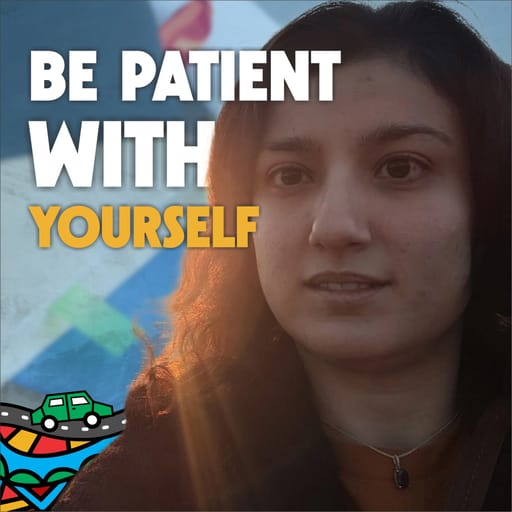
Transcript 0:00 Just before I recorded this episode with Gülsün, I lost my dad. You know, and grief is a pretty interesting thing to deal with, you know, no matter who you are or where you are. 0:14 But I think it's extremely difficult or even more difficult if you're an immigrant, you know, because, you know, you're far away from home. Like, so for example, for me, I was here 0:24 in Canada, and then I get told that my dad has passed, and I don't get to go home till, like, my dad passed July. I didn't travel back home till, like, September, you know? 0:37 So you're trying all you wanna do from here, but you're just so distant from everyone. Yeah, you have your, your wife and your kids and all that stuff, or you have friends, depending on who your partner. But it's, 0:51 it's just a very interesting dynamic because you're so far away from all that's happening. You wanna see your loved ones, you wanna see your siblings, you wanna console them, and I'm the first kid. 1:01 And, you know, it's, it's just a tough thing. And, you know, so when Gülsün talked about in how-- when she was talking about, you know, dealing with losing someone, like, as an immigrant, like, it's tough. 1:12 Like, it's really tough, and I don't know what else to say. [chuckles] In the past 1:20 y- few years, uh, I lost my uncle and I lost my grandmother, so during those times, uh, I really wished I could travel and just be with my family or just, just see these people when they were passing away. 1:37 So especially, uh, I think during hard times, uh, when my family is going through hard times, I truly wish, I wish I was there. And yeah. 1:50 And so, you know, aside from just grief, asi- aside from talking about grief, we, we did talk about a lot more interest- a lot of interesting things. It wasn't all sad. 1:57 You know, when we talked about, you know, missing home, which I think is a recurring theme among all the immigrants I talk to. You know, everyone misses home one way or the other. 2:05 But I think for me, one big thing we talked about, me and Gülsün, was just, you know, the idea that you don't kind of feel settled. You know, you're always trying to settle, you know? 2:15 I mean, she's been here for six years. I'm just here two years plus, and I mean, I don't feel settled. She's six years plus, and she doesn't feel settled. So enjoy. Hey, everyone. 2:25 Welcome back to the Newcomers Podcast, where I chat with immigrants like myself. Today, I have with me Gülsün, who's been in Canada for, like, six years. How have you been? 2:36 So thank you for hosting me today, and I've been doing well. Yeah. Thank you. Hope you're well too. Yeah. I'm well. I'm well. And so let's get straight to it. 2:44 I think for me, like, the first question is, is what does it feel like after six years? Like, do you feel like, "I'm settled in," or do you feel like, "Hmm, this, this isn't what I wanted?" [chuckles] Yeah. So [chuckles] 2:59 it's a very tricky question. So I ask this question, um, to myself always as well. So, uh, I'm-- I can't say, like, I've settled in 100%. 3:12 So now I think I feel like I think most of the people who attended [chuckles] in your podcast as well. So I- I'm like... I don't know. It's confusing. I'm either, like, 3:29 in here or, like, sometimes my heart is always in Turkey, where I am from, so. Hmm. You-- Let, let's, let's ex- let's sit on that a bit, and let's explore that feeling. So d- do you, like... 3:44 So is it a, is it a function of I miss home? Is it a function of, oh, there's so many things here that reminds me that I'm not home? What do you-- Can you place what exactly is driving all those feelings? Yeah. 3:58 So, um, so the feeling is something like this. 4:02 So, uh, when I am home, sometimes I miss Canada, and when I'm in Canada, there are occasions that I would really wish, I wish I was back home. So yeah, that's the feeling- [laughs]... 4:20 of being an immigrant. [chuckles] [laughs] Yeah. D- Well, like, you wanna talk a bit about one or two of those occasions when you're like, "Yeah, I wish I was home." Like, can you just give an example of one of them? 4:30 Yeah, for sure. 4:32 So for example, um, in the past y- few years, uh, I lost my uncle and I lost my grandmother, so during those times, uh, I really wished I could travel and just be with my family or just, just see these people when they were passing away. 4:53 So especially, uh, I think during hard times, uh, when my family is going through hard times, I truly wish, I wish I was there. And yeah. Yeah. 5:06 That's, that's so true because, I mean, I'm currently dealing with grief right now. I lost my father two weeks ago. I'm so sorry. Yeah. Thanks. 5:14 And, like, it's horrifying because you're, you're here, and they're all back in Nigeria, and, um, I, I can't do anything. All I can do is just grieve, you know? So I, I, I get you. 5:31 Like, it's, it's a really hard thing to deal with, and that's something people don't talk about enough, just the fact that, yeah, you're, you're probably here doing stuff, but then when you lose someone that is back home, 5:42 and for some reason you j- I mean, you just can't go back immediately, and it's just you and your, maybe your close ones trying to deal with the loss, and you can only talk about it with a phone and while you're trying to understand what happened. 5:55 But let's not get too sad. [laughs] Let's not, let's not get too sad. Let's go back to your first night when you came. That first night when you landed, how did it feel for you? 6:06 Like, were you excited or were you-Okay, what's going on? Yeah. So, um, 6:13 first time, uh, I think the first time when the feeling kicked in was actually when the plane was landing, uh, to Canada, like, you know, um, because I was landing at Toronto, so I've seen all these like skyscrapers, and it was also, uh, almost like, I believe 9:00 PM, 10:00 PM as well, so it was night as well. 6:35 So, uh, the feeling was like, "Oh my God, what am I gonna do? Like, now, okay, I, I, I took this decision and now I am in Canada, so what, what now?" 6:47 And also, when I first came, uh, to Canada, I did not have a house, so first I booked, um, in a hostel room for a couple of weeks, uh, because I've never been to Canada before, so I, I did not have an idea of like how the rental works, how, how... 7:09 where am I going to stay, et cetera. So I just booked in a hostel, uh, in the city center. And then, um, afterwards, I took 7:21 the train to the city, and then I was just with my suitcases like on King Street, and I was like, okay. 7:29 And I, I, I mean, I did not have data on my phone, I just had a map [chuckles] that I printed out on my way to hostel. And I was like, okay, why, why would I do that? 7:40 And I did not think about arriving in late as well, so I was like, okay, yeah, like this was not even a [chuckles] good preparation on my end. 7:49 And then I met a random, uh, person on the street, so she told me, uh, "Are you going to the hostel?" And I said, "Yes." And then she said, "Which one?" 8:00 And then I told her which one I was going to be staying at, and I just trusted this person. She just told me like, "Oh, it's five minutes from here. Just follow me." And then [chuckles] 8:11 she took me to the hostel, and that was my first night. Yeah. That's, that's amazing. Like, it's amazing. And then when you were following the stranger, what were you thinking about? 8:24 Like, what was going through your mind all that, all that time like? [chuckles] Um, honestly, like I, I didn't have a lot of options at the time. Like I... 8:33 as I mentioned, like I had the map, so I kinda knew that it, the hostel wasn't that far. So I was like, okay, I'll, I'll probably just like follow [chuckles] this person, and then that was it. 8:45 Yeah, I just had to trust, I guess [chuckles] to this person. I don't know. I mean, after obviously living in Canada for the past six years now, I don't... 8:54 I know that it may not [chuckles] be the best decision, but at the time it worked out. Yeah. Yeah. Yeah. Yeah. 9:02 I, I like the idea of faith, like in the sense that at that time, that's the best decision and like that's the best you can do at that point in time. What else are you gonna do? Say no and- Mm-hmm... 9:12 stay stranded on the street? And then so after that, so y- so what next happened for you? Like, was it just... Like, how was it next? Now, now the process of settling in, d- did you go straight to... 9:23 You came for school, right? Yes. With- So I moved to Canada, uh, to pursue my PhD education. Okay. 9:31 So, um, so what happened next was I went to school, I met people there, and then I started looking for a housing immediately. 9:42 And, um, one thing to mention, I guess, uh, as a concept of this podcast too, for like potential newcomers or other newcomers, is that, so because, uh, I come from Turkey, right? 9:55 So at the time, uh, the economical situation in Turkey was not that bad. So, uh, one Canadian dollar was, um, two Turkish lira. So as of today, I think it's over 19. So [chuckles] you- Yeah... can tell the difference. 10:12 So at the time, I had a little bit of confidence, uh, uh, from my family in terms of finances, 'cause they told me that, "If things, uh, don't go well, we could support you," because I was on a scholarship, and, uh, the math was like fine if, if I t- had this scholarship, then I could sustain myself. 10:33 So I had that, uh, confidence. And then obviously I had a very limited budget. And, um, so next step was me finding a basement room. Uh, so I rented a room, it was for $600. And [laughs] 10:50 I think my monthly salary was around $1,000 or something. I remember it being less than the minimum wage at the time. So I found, I found this room, I rented it for six months. 11:03 And, uh, so I have to mention that I don't come from an extremely rich family, but in my previous university in Turkey, I was living in a dormitory room, and my room 11:16 had the view of the Bo- uh, Bosphorus and all these, uh, you know, the bridge and like you could see [chuckles] the Asian Minor, et cetera. 11:26 So that was my, uh, situation in Turkey, whereas I found this room and, uh, my [chuckles] my room was in a basement room. I never lived in a basement before. 11:39 And the window, there was only one window, and it was just, uh, as small as the screen of my laptop. So I w- I said, "Okay, so this is gonna be my life for a little bit." And, um, 11:55 it was a lot of, I think, shock and downgrading because when people, I guess, plan on immigration, sometimes they miss some of the factors because the idea is having some changes in our lives, and potentially when you took these, uh, risks, uh, I think-You believe that you are gonna have a better life, but sometimes it doesn't come that fast. 12:26 So there is this, like, period of, I think, [chuckles] waiting and working hard on your goals. Uh, so, mm, yeah, that was my first like six months that I lived in, in a, in a basement room. 12:42 Yeah, I was sharing, uh, the basement, uh, with other people, yeah. That is-- [laughs] 12:50 I can imagine just going from living in a room where you have so much light to going, living to a place where you just have a small, uh, sliver of light coming in through the window. Now, just kinda exploring all the... 13:06 So those first s- if you think about those first six months, you know, and you think about your life now, like what's the biggest difference in how you approach it from a, from all points of view, mental, emotional? 13:19 Like how-- what's the difference for you right now? Yeah, for sure. I think that's a great question. 13:24 So, um, I mean, I think the first, I would say couple of years perhaps was kinda like navigating the life in North America, 'cause, um, as I mentioned, I'm from Turkey, and before Turkey, I also lived in Sweden, but it still was a European country. 13:45 And, um, so I would say North America is pretty different [chuckles] than anywhere else in the world. So the first six months, uh, were very challenging, uh, for me. Um, 14:03 everything, I found everything was different, so I was not expecting some of the differences, um, including the healthcare system, the tax system. Um, I had to learn everything from scratch. 14:18 [chuckles] And right now, so, uh, what has changed is obviously I graduated a couple of years ago, so now I have a full-time job. And when I was a student, I also worked in several jobs. 14:33 For example, I worked at the restaurants, I worked at a food bank, I worked at coffee shops. So now I think the difference is obviously I w- I do not live in a basement room anymore. 14:47 [laughs] I was able to rent my own apartment. Um- Yay. [laughs] And I have a full-time job, and when I first moved to Canada, I was, uh, on a student visa. 15:00 Then after I graduated, I was on a work visa, and now I'm a permanent resident of Canada. So I think these changes gradually also had a better impact of my quality of life in this country as an immigrant. 15:18 Uh, I wish obviously I had the same conditions, uh, since day one, but if you do not have, uh, a lot of money, I guess, before moving to a new country, um, be prepared for challenges, yeah. 15:35 [laughs] Yeah. 15:36 And, and I'm gonna kinda ask you another que- and I, this is a, it's, it's a hard question, uh, but so I apologize ahead of time, but it's almost like saying to me like, what's, like what are those convictions? 15:45 Like, you know, you said something about how moving from being student visa to the work visa to being a permanent resident, how that has changed, like how it has impacted your quality of your life. 15:57 I just would, I want us to kind of dig into that a bit. Like did you mean quality of life in terms of how you view it itself or financially, or is it a mix of both? Um, so, um, 16:10 I think it kinda gives you an ease of mind, I would say. Um, why? Because, for example, I think being on a visa means you have a return date, uh, and either or that. 16:26 Like if you might, if you lose your job, let's say, you may not find a new job and then, you know, you may need to go back to your country, et cetera. 16:36 When you have, uh, let's say a permanent residency, you could get your health card that is not going to expire, or you don't need to worry about visa applications, um, those kind of things. I think not... 16:51 I, I don't know if it necessarily brought the financial [chuckles] freedom or anything. I don't think there is a drastical change. 16:59 But what I figured was, because I recently became a permanent resident, even though I live in Canada for too long, is that I realized when I was changing my Social Insurance number, uh, after, uh, receiving my permanent residency, so my Social Insurance number 17:18 used to start with nine, and now it starts with one. So I think it is kind of like to mark people, uh, whether you're on a visa or, or not. 17:33 I mean, it, I, I, uh, of course, this is another, I think, a debate topic that I ha- would have a lot of critics on, but, um, what I figured is, yeah, it's, it's, I think kinda ga... 17:46 It gave me a little bit of more of a confidence, I guess, now, yeah. Yeah. 17:52 I like that point you make about that f- the feeling that when you're on a visa, it always feels like you have a return date, and that date just kind of stays at the back of your mind. It just ne- it never goes away. 18:02 It just stays there, you know, and then whatever you do, you're always like, "Oh yeah," like, "I need to make sure that I extend my return date." [laughs] And now, um, what do you miss most about home? 18:14 I know you've kind of talked about this a bit, but just, just putting that, like what do you miss most? 18:18 Like out of all the things you talked about your home country and Canada, what do you miss the most?Um, sometimes I just miss, uh, my family, just being with my family. 18:28 Like when I am very sick or when I'm very busy, for example, I wish like I was surrounded [chuckles] by my family or friends. 18:37 Um, but at the same time, so one of the things is that I realized that my country also has changed in the past like five years. Nothing is the same. 18:49 So when I visit back, I also do not find, um, my country being the same as in the time that I left. So I think there is this like feeling of nostalgia [chuckles] 19:04 to my old life back home, like when things were a little bit more stable, et cetera, or like political challenges, et cetera, that I will not be going into details. 19:15 But, um, so I would say I think I just missed overall the most like the feeling of, uh, belonging and, and the solidarity. Uh, yeah. 19:27 For example, when, uh, the earthquake happened, uh, my workplace was very understanding. My supervisor was very understanding, and he, uh, directly emailed me about the situation, and he, uh, was checking up on me a lot. 19:43 But at the same time, life goes on and the work goes on. So, and, um, I work with, um, people from the United States as well, so they-- those negative events, for example, may not be their reality. 20:00 So it was not, um, um, it was not well acknowledged by some people, for example, or, but some people did acknowledge it that, but these things. So 20:13 I think, yeah, the feeling of solidarity and, um, yeah, being, uh, with your community sometimes is the things that I miss the most. Hmm. I can imagine. Yeah. 20:28 I mean, I guess sometimes people find it, sometimes people find it hard to put themselves in your shoes. Mm-hmm. 20:36 Especially in a world where everyone or is a society where it's very individualistic, then it can get harder, you know, which is one thing that North America, I've come to realize with North America is that 20:48 it's everyone-- it's a, it pushes a you over others mentality, and then that shows up across in various parts of life in different ways. Some of them we like, some of them we don't like. Yeah. 21:01 But I guess that's, that's the society we live in. Have you ever regretted being here? Sorry? Have you ever regretted being in Canada? Um, [chuckles] not really. 21:17 I think the moments that like, not a regret, but like sometimes I wish that, you know, we were closer to other parts of the world. 21:27 [laughs] Uh, it's not necessarily being close to Turkey, uh, only, but you know, when, let's say you're in Europe, you could just take a Ryanair, and then you could spend the weekend in, I don't know, somewhere else. 21:40 So sometimes I just feel, I think I, I h-had this feeling immensely during the pandemic as well, but I sometimes wish that, I wish, you know, we had more opportunities of traveling and seeing, um, other places. 21:57 'Cause I like traveling a lot, but sometimes I just feel like I'm just stuck in Ontario. 22:03 Even like going to British Columbia or Alberta, like where you are [chuckles] at the moment, it takes, uh, hours to just take a plane and just be there. Yeah. Yeah. 22:14 I mean, 'cause I, I, I just came up from Ottawa on Friday. It's like a four-hour flight. Yeah. I'm like, how did you fly for four hours within the same country? [laughs] Yeah. Yeah. 22:25 That's absolutely-- I mean, I forgot that you and I might have different time zones even, so. Mm-hmm. Mm-hmm. Mm-hmm. And so, you know, dig in, talking a bit about your, your, your, your journey so far, 22:40 like what has been your most overwhelming moment? And I think maybe I should split it into two. So 22:47 if you think about it, when you just came in, the first one year, what was your most overwhelming moment during that period of transition? 22:54 And if you think about it in general, now that you're much more settled, do you still have these moments of overwhelm where you're like, "Oh, wow." Like you just get, I don't know. 23:04 You know how the feeling can be when you deal with it. Yes. Um, yeah. So I think in the first couple of years, as I mentioned, like when I was a student, I, I did like different kinds of jobs. 23:18 So while being a student and while I guess working in these jobs were overwhelming, and at the time, I think now they have changed these regulations, but the students, international students were limited to working for 20 hours per week only. 23:36 So that was one of the overwhelming things. And other overwhelming things would be how challenging the life was for some of the international students. So I was not the only international student. 23:51 Most of the graduate students were international students. 23:55 So having this comparison, even though sometimes it's not very nice to compare yourself with others, I would just find myself comparing with, let's say, domestic students. 24:06 And, you know, you have to think about, even though you're on a scholarship, like you have to think about your student fees and other fees that are like almost twice or three times more than a regular stu- I mean, a domestic student. 24:19 So that was one of the most overwhelming things. Other things were that-So I think, yeah, I think surrounding that. And afterwards, uh, after I graduated, always, uh, I went to school for being a researcher at first. 24:37 So I, I did a PhD in mechanical and industrial engineering, but, um, I did not continue in academia, so that was another overwhelming experience for me because I had to change my plans, seeing, uh, 24:55 the limited opportunities for PhD graduates in terms of finances and stability again. So I had to also continue in industry even though I was trained, uh, to be a researcher. 25:11 So that was another overwhelming moment that, uh, yeah, um, not being able to use my degree as much. Uh, of course, like, the skills are transferable, and there is no problem with that. 25:26 But of course, from time to time I feel overwhelmed because sometimes I just remember that I have a PhD, but [laughs] I am not using my PhD as much. 25:39 [laughs] And yeah, because another overwhelming thing I, uh, observed was because last summer I was also teaching at a college, uh, at Seneca College, in fact, in Toronto, while I was working as a full-time engineer. 25:57 So that was also overwhelming, holding two jobs, because things don't end when you just graduate and find a job. As you mentioned, like, 26:08 being stable as an immigrant takes time because you are already, as I mentioned, like with social insurance number or with the accent or other aspects, being a woman, et cetera, uh, you're already labeled as an immigrant. 26:24 And I think in one of, uh, your podcast episodes, I think one of the participants were also mentioning about that, that it, it, it actually doesn't go away. So yeah- Yeah. It never goes away... 26:35 that's always overwhelming. Yeah. It never goes away, to be honest. Yeah. Like, you know, it's, I mean, it never really goes away. You just-- 26:43 You-- I think in the end, you, you just decide yourself that you're gonna just face it and deal with what it is. But yeah, you always have an accent unless you wanna change it, and not everyone... 26:54 Like, I am not gonna change my accent for anyone. This is how I talk, and if you don't like it, then so be it. Mm-hmm. Yeah. Yeah. So I think the last question I have for you would be, 27:06 if you look back on your journey now, what would you have done differently? Um, I think I would be more patient with myself. Mm. 27:20 And in my humble opinion, if I were to give an advice [laughs] to a newcomer, 27:28 people like myself or, like, people from, let's say, Nigeria, like, developing countries, I would say, 'cause that's also a different set of being an immigrant too. It's not the same as being an immigrant from Europe. 27:41 Of course, it would bring its own challenges too, perhaps. 27:44 But for us, let's say for people from developing countries, I would say, um, being more patient, uh, with ourselves, because as we've been talking, um, things take time, and there will be challenges, and sometimes we don't oversee these challenges of life because we immigrate with high-- having high hopes. 28:11 So I think, yeah, I would be more patient with myself. So at the end of the day, I graduated, I found a job, I got my permanent residence, et cetera. Um, 28:22 things might take time, and sometimes things take time more than other people. So again, I think, uh, I would do the comparison less because everyone has their own journey, everyone has their own timing, and people 28:40 will blossom when it's their, their time. I think that's what I want to say. So I would do this differently. Um, yeah. Mm-hmm. Yeah. That idea of being patient with yourself is really powerful. 28:55 Like, yeah, just be patient. It takes time to settle in. Like, because people underestimate how much of a job it is to 29:08 uproot yourself from your country, leave everything you know behind, and just go to a new country and just start trying to root yourself again. You know, especially if you're not a kid. 29:18 Like, if you're a kid, it's probably easier, but if you're an adult, like, it just takes, it takes a lot out of you that is not spoken about. Like, I'm not sure I've even finished unpacking the layers of all that. 29:29 I'm hoping that by the time I'm done, 29:32 if I'm ever done with this podcast, [laughs] like by, by the time you do a lot more interviews, you start to unpack all those layers guest by guest, 'cause there's so many layers that people are dealing with or have to pass through. 29:43 But thank you so much, Gulsen. This was really good. Thank you for your honesty, and thank you for sharing your time with me today. Yeah. Thank you so much. I really enjoyed, uh, our conversation. 29:52 It was a great journey for me. Like, I felt, you know, I went back in time and [laughs] remembered my first night. It's been a while that I haven't thought about my first night, so [laughs] thank you. 30:04 It's a good-- Yeah, it's a good... Thank you so much. [upbeat music] So as immigrants, um, I feel like we are always in a hurry, you know? Um, and I don't blame anyone. 30:15 You come here, depending on how old you are when you come here, um, you feel like you have goals to meet, you have things you need to do, and so we are always in a hurry. 30:23 You know, we are-- We have these things that we have to achieve by certain time or certain milestones. But you know what? 30:30 If there's one thing you take from Gulsen's episode, I think it's just this thing she said when she says, "Be patient with yourself." Honestly, like, just be patient with yourself. Like, 'cause you know what? 30:43 [upbeat music] Not every new day is a gift, and so enjoy it as much as you can and just be patient with yourself. Forgive yourself when things don't go according to plan. You will make mistakes. You, you'll learn. 30:56 You're in a new environment. Just be patient with yourself. And with that, as usual, please thank you all. Thank you so much for listening to this episode. Please share, like. 31:06 You know, if you have someone who you think would enjoy this episode, please share this with them. [upbeat music]